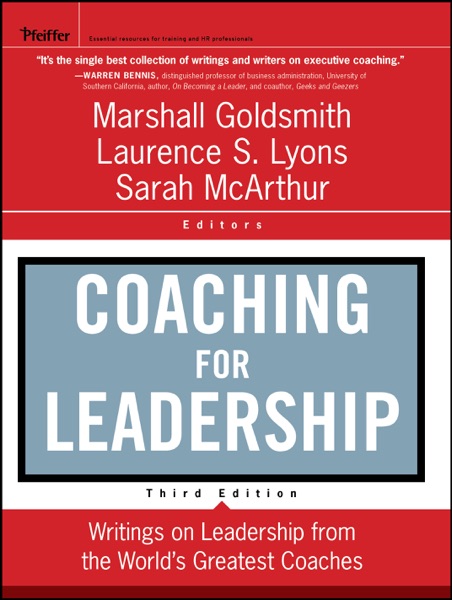
Coaching for Leaders
📖 About the book
Coaching for Leaders (drawing from Marshall Goldsmith’s extensive research and his book The Leader of the Future) is a specialized guide to the Behavioral Transformation required for top-tier success. Goldsmith, the world’s #1 ranked executive coach, argues that the higher you go in an organization, the more your problems are behavioral rather than technical. This book provides a rigorous, results-oriented framework for leaders to improve their personal effectiveness by focusing on the perceptions of those they lead.
The core methodology centers on the Stakeholder Centered Coaching model and the revolutionary Feedforward technique. Instead of dwelling on past mistakes (feedback), Goldsmith teaches leaders to ask for future-oriented suggestions for improvement. He emphasizes the importance of Follow-up and the role of 'Helpfulness' in building influential relationships. He introduces the concept of 'Leadership is a Contact Sport,' arguing that change only happens through constant interaction and public accountability. The focus is on moving from 'Successful-and-Arrogant' to 'Successful-and-Evolving.'
Essential reading for senior executives, HR business partners, and leadership consultants. Readers gain concrete value by learning how to eliminate the 'annoying habits' that stifle team performance. Practical applications include utilizing Stakeholder Surveys to track progress and implementing 'Peer Coaching' groups focused on behavioral outcomes. By mastering Goldsmith’s coaching logic, leaders can build a reputation for humility and continuous improvement, ensuring they remain relevant and effective as they navigate the peak of their careers.
💡 Key takeaways
Implement the Feedforward Technique by asking stakeholders for specific suggestions for the future rather than debating past performance, accelerating your behavioral growth.
Utilize Stakeholder-Centered Coaching to involve your team in your professional development, creating a culture of mutual accountability and transparent improvement.
Commit to Continuous Follow-up, recognizing that lasting leadership change requires consistent, repetitive measurement of behavioral progress over months and years.
❓ FAQ
Is "Coaching for Leaders" by Marshall Goldsmith free to download?
Yes. BookHubs provides a free preview for "Coaching for Leaders". For the full legal text we link to OpenLibrary (Internet Archive), which is also free to read.
What is "Coaching for Leaders" about?
Free download of Marshall Goldsmith's coaching guide. Master the 'Feedforward' technique to drive behavioral change and executive growth.
How long does it take to read "Coaching for Leaders"?
At an average reading pace of ~250 words per minute, "Coaching for Leaders" (224 pages) takes roughly 336 minutes — about 5.6 hours. The 3 key takeaways on this page cover the core ideas in under 5 minutes.
What is the ISBN of "Coaching for Leaders"?
The ISBN of "Coaching for Leaders" by Marshall Goldsmith is 978-0787901844, published by Jossey-Bass.
📚 Related books
All books →
The 21 Irrefutable Laws of Leadership
John Maxwell

Dare to Lead
Brené Brown

How to Win Friends and Influence People
Dale Carnegie

Shoe Dog
Phil Knight

The Laws of Human Nature
Robert Greene

Think Again
Adam Grant