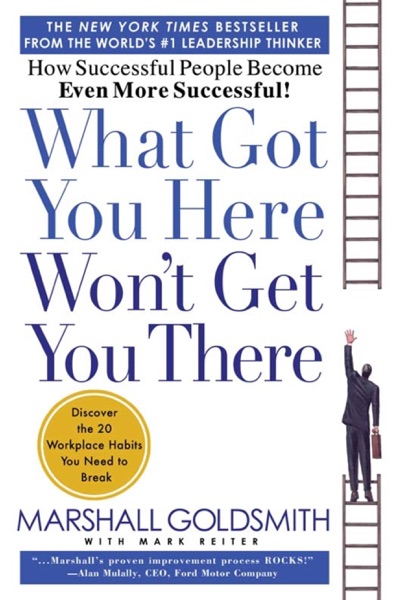
What Got You Here Won't Get You There
📖 About the book
What Got You Here Won't Get You There by Marshall Goldsmith, published in 2007, is a sobering wake-up call for successful professionals. Goldsmith argues that the very behaviors that helped you rise to the top—such as self-confidence and competitive drive—can become the obstacles that prevent you from reaching the next level. This book provides a diagnostic manual for identifying the Behavioral Blind Spots that successful people often ignore, offering a disciplined process for achieving positive, lasting change in leadership style.
The book identifies the 20 Habits That Hold You Back, including 'Winning too much,' 'Adding too much value,' and 'Making destructive comments.' Goldsmith introduces the Process of Apologizing and 'Active Listening' as the primary tools for repairing damaged professional relationships. He emphasizes the importance of Feedforward and provides a seven-step framework for change: Ask, Listen, Thank, Think, Apologize, Follow-up, and Practice. The focus is on moving from 'Smart-and-Competitive' toward being a leader who empowers others and builds institutional trust.
Essential reading for middle and senior managers who have hit a 'career plateau.' Readers gain value by learning how to recognize the subtle ways they alienate their teams. Practical applications include utilizing 360-Degree Feedback to identify specific annoying habits and implementing 'Daily Question' rituals to maintain self-discipline. By mastering Goldsmith’s behavioral insights, leaders can ensure that their professional growth continues to match their technical expertise, allowing them to lead with greater influence and empathy.
💡 Key takeaways
Identify your Behavioral Blind Spots by reviewing the 20 habits that hold successful people back, such as the need to 'win too much' in every interaction.
Practice Active Listening and the 'Apology Process' to restore damaged relationships and build a high-trust environment where team members feel heard and respected.
Apply the Seven-Step Change Framework to systematically replace your negative habits with high-impact leadership behaviors that support your organization's long-term goals.
❓ FAQ
Is "What Got You Here Won't Get You There" by Marshall Goldsmith free to download?
Yes. BookHubs provides a free preview for "What Got You Here Won't Get You There". For the full legal text we link to OpenLibrary (Internet Archive), which is also free to read.
What is "What Got You Here Won't Get You There" about?
Free download of Marshall Goldsmith's classic for free. Learn the 20 habits that hold successful leaders back and how to overcome them.
How long does it take to read "What Got You Here Won't Get You There"?
At an average reading pace of ~250 words per minute, "What Got You Here Won't Get You There" (256 pages) takes roughly 384 minutes — about 6.4 hours. The 3 key takeaways on this page cover the core ideas in under 5 minutes.
What is the ISBN of "What Got You Here Won't Get You There"?
The ISBN of "What Got You Here Won't Get You There" by Marshall Goldsmith is 978-1401301330, published by Hyperion.
📚 Related books
All books →
The 21 Irrefutable Laws of Leadership
John Maxwell

Dare to Lead
Brené Brown

How to Win Friends and Influence People
Dale Carnegie

Shoe Dog
Phil Knight

The Laws of Human Nature
Robert Greene

Think Again
Adam Grant