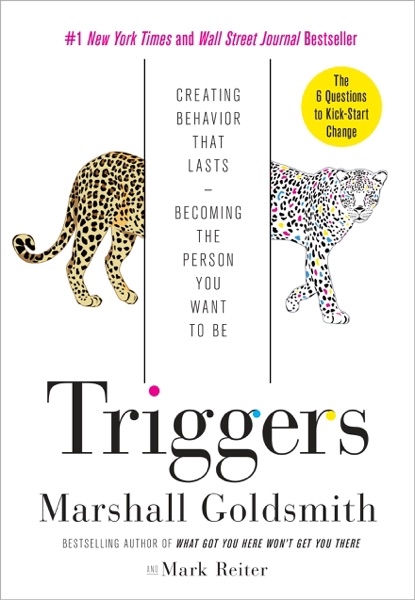
Triggers
📖 About the book
Triggers: Creating Behavior That Lasts—Becoming the Person You Want to Be by Marshall Goldsmith, published in 2015, explores the environmental and psychological forces that derail our best intentions. Goldsmith argues that we are not the masters of our surroundings; instead, our Environment is a Trigger that often provokes impulsive, non-productive reactions. This book provides a rigorous, data-driven framework for regaining control of our choices and building the discipline needed to sustain high-performance leadership behaviors in any context.
The core methodology centers on the Six Engaging Questions and the practice of 'Active Inquiry.' Goldsmith explains the distinction between Passive vs. Active Triggers and introduces the 'AIWATT' (Am I Willing At This Time...) mantra for mindful decision-making. He details the importance of Self-Monitoring and provides the logic for the 'Daily Questions' ritual, where leaders rate themselves on their effort to improve. The focus is on moving from 'Intent' to 'Execution,' acknowledging that willpower is a finite resource that must be supported by structured systems and environmental design.
This is crucial reading for executives, high-performers, and anyone seeking to break chronic patterns of procrastination or reactivity. Readers gain value by learning how to anticipate their personal 'danger zones' and design Behavioral Buffers. Practical applications include utilizing 'Daily Progress Reports' and redesigning office layouts to support Strategic Focus. By mastering the science of triggers, leaders can ensure that their professional conduct is an intentional expression of their values, rather than a reactive response to the daily chaos of the business world.
💡 Key takeaways
Utilize Active Inquiry by asking yourself daily questions that focus on your 'effort' rather than just 'results,' fostering a high level of personal accountability.
Apply the AIWATT Mantra—Am I Willing At This Time to make the investment required to make a positive difference?—to prevent impulsive and non-productive professional reactions.
Audit your Environmental Triggers to identify the specific people and situations that derail your strategic focus, and design structural 'buffers' to mitigate their impact.
❓ FAQ
Is "Triggers" by Marshall Goldsmith free to download?
Yes. BookHubs provides a free preview for "Triggers". For the full legal text we link to OpenLibrary (Internet Archive), which is also free to read.
What is "Triggers" about?
Free download of Triggers for free. Learn how to control your environment and create lasting behavioral change with Marshall Goldsmith's proven techniques.
How long does it take to read "Triggers"?
At an average reading pace of ~250 words per minute, "Triggers" (272 pages) takes roughly 408 minutes — about 6.8 hours. The 3 key takeaways on this page cover the core ideas in under 5 minutes.
What is the ISBN of "Triggers"?
The ISBN of "Triggers" by Marshall Goldsmith is 978-0804141239, published by Crown Business.
📚 Related books
All books →
The 21 Irrefutable Laws of Leadership
John Maxwell

Dare to Lead
Brené Brown

How to Win Friends and Influence People
Dale Carnegie

Shoe Dog
Phil Knight

The Laws of Human Nature
Robert Greene

Think Again
Adam Grant