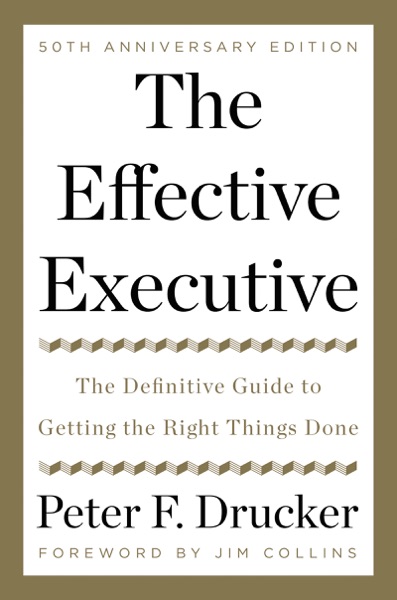
The Effective Executive
📖 About the book
The Effective Executive by Peter Drucker, first published in 1967, is a timeless masterpiece that defines the essence of modern management. Drucker, the father of management theory, argues that effectiveness is a skill that can—and must—be learned. He shifts the focus from efficiency (doing things right) to effectiveness (doing the right things), contending that the primary duty of an executive is to produce results. This book remains the definitive guide for anyone looking to navigate the complexities of knowledge work and organizational leadership.
Drucker outlines five essential practices for effectiveness: Managing Time, focusing on contribution, making strengths productive, prioritizing "first things first," and making effective decisions. He emphasizes the Consolidation of Discretionary Time, arguing that executives must ruthlessly eliminate tasks that provide little value. He also introduces the concept of Focus on Contribution, where leaders ask, "What can I contribute that significantly affects the performance and results of the institution I serve?" This mindset ensures that individual efforts are aligned with the organization's strategic goals.
Essential for managers, knowledge workers, and aspiring leaders, this book provides a roadmap for peak professional performance. Readers gain value by learning how to prioritize high-impact tasks and avoid the "trap of the urgent." Real-world applications include conducting a Time Audit to identify waste and structuring meetings to ensure meaningful outcomes. By internalizing Drucker's principles, individuals can transform their work habits, moving from being merely busy to becoming highly effective contributors who drive measurable organizational success.
💡 Key takeaways
Practice Time Management by ruthlessly eliminating non-productive activities and consolidating your remaining discretionary time into large, usable blocks for high-impact work.
Maximize your impact by adopting a Focus on Contribution, aligning your personal work goals with the broader performance and results of the entire organization.
Implement a "First Things First" priority system, focusing your best efforts on the most important tasks and Postponing or Eliminating those of secondary importance.
❓ FAQ
Is "The Effective Executive" by Peter Drucker free to download?
Yes. BookHubs provides a free preview for "The Effective Executive". For the full legal text we link to OpenLibrary (Internet Archive), which is also free to read.
What is "The Effective Executive" about?
Download The Effective Executive for free. Master the art of getting the right things done with Peter Drucker's classic guide to time management and focus.
How long does it take to read "The Effective Executive"?
At an average reading pace of ~250 words per minute, "The Effective Executive" (208 pages) takes roughly 312 minutes — about 5.2 hours. The 3 key takeaways on this page cover the core ideas in under 5 minutes.
What is the ISBN of "The Effective Executive"?
The ISBN of "The Effective Executive" by Peter Drucker is 978-0060516079, published by HarperBusiness.
📚 Related books
All books →
7 Habits of Highly Effective People
Stephen Covey

High Output Management
Andrew Grove

The Righteous Mind
Jonathan Haidt

Antifragile
Nassim Taleb

Business Model Generation
Osterwalder, Pigneur

Management
Peter Drucker