Management
📖 About the book
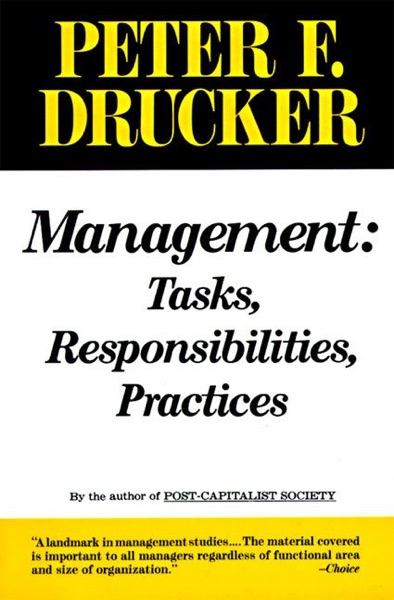
Management: Tasks, Responsibilities, Practices by Peter Drucker is widely considered the "bible" of management. Published in its most comprehensive form in 1973, it serves as an exhaustive encyclopedia of everything a manager needs to know to lead an institution in a modern society. Drucker synthesizes decades of experience and research into a structured framework that covers everything from corporate governance to individual productivity, providing the theoretical and practical tools necessary for organizational health.
The book is divided into three main sections: the tasks of management, the manager's work and responsibilities, and the design of management. Drucker expands on his theory of the Social Responsibility of Management, arguing that businesses must contribute to the public good to maintain their legitimacy. He delves into Organizational Structure, exploring the strengths and weaknesses of functional, divisional, and matrix designs. A significant portion is dedicated to Management of the Knowledge Worker, a term Drucker coined to describe the shift from manual labor to mental expertise as the primary source of economic value.
This is the ultimate reference for senior executives, academics, and consultants. Readers gain unparalleled depth in understanding how to manage complex global organizations. Real-world applications include redesigning Performance Measurement Systems to account for long-term health and structuring management teams to handle multi-national operations. By studying this volume, leaders gain a comprehensive perspective on their role, allowing them to build organizations that are not only profitable but also resilient, ethical, and capable of sustained innovation.
💡 Key takeaways
Design your Organizational Structure based on specific performance requirements, choosing the right model (divisional, functional, or matrix) for your industry's complexity.
Prioritize the Management of Knowledge Workers by providing them with the autonomy and continuous learning opportunities required to maximize their mental output.
Balance short-term profitability with the Social Responsibility of Management, ensuring your institution’s long-term legitimacy through ethical conduct and public contribution.
❓ FAQ
Is "Management" by Peter Drucker free to download?
Yes. BookHubs provides a free preview for "Management". For the full legal text we link to OpenLibrary (Internet Archive), which is also free to read.
What is "Management" about?
Download Peter Drucker's definitive guide to management for free. A comprehensive encyclopedia of tasks, responsibilities, and practices for every leader.
How long does it take to read "Management"?
At an average reading pace of ~250 words per minute, "Management" (864 pages) takes roughly 1296 minutes — about 21.6 hours. The 3 key takeaways on this page cover the core ideas in under 5 minutes.
What is the ISBN of "Management"?
The ISBN of "Management" by Peter Drucker is 978-0060110925, published by Harper & Row.
📚 Related books
All books →
7 Habits of Highly Effective People
Stephen Covey

High Output Management
Andrew Grove

The Righteous Mind
Jonathan Haidt

Antifragile
Nassim Taleb

Business Model Generation
Osterwalder, Pigneur

Out of the Crisis
W. Edwards Deming