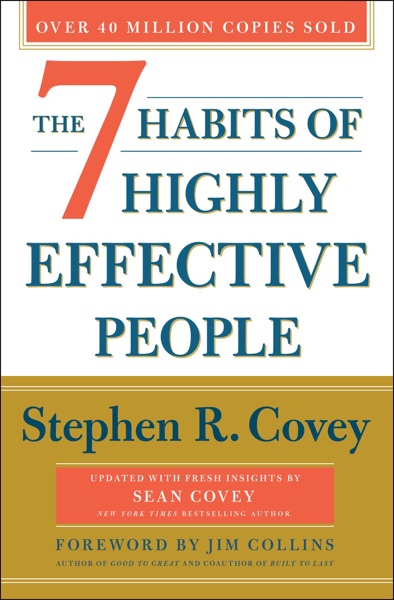
7 Habits of Highly Effective People
📖 About the book
The 7 Habits of Highly Effective People by Stephen Covey, published in 1989, is one of the most influential business and personal development books of all time. Covey argues that true success is not based on quick-fix 'personality ethics' but on timeless, universal Character Principles. By internalizing these seven habits, individuals can move from dependence to independence and finally to the peak state of Interdependence, which is essential for leading high-performance teams and organizations in a complex world.
The habits are divided into three groups: Private Victory (Be Proactive, Begin with the End in Mind, Put First Things First), Public Victory (Think Win-Win, Seek First to Understand, Synergize), and Renewal (Sharpen the Saw). Covey introduces the Circle of Influence vs. the Circle of Concern and the Emotional Bank Account as a primary framework for building trust in relationships. He emphasizes the P/PC Balance—the balance between production (results) and production capability (the assets/people that produce results)—as the key to long-term organizational health.
Essential for managers, parents, and anyone seeking to lead with integrity. Readers gain value by learning how to align their daily actions with their deepest values. Real-world applications include using Empathetic Listening to resolve client conflicts and utilizing 'time-management matrices' to prioritize high-impact strategic work. By practicing these seven habits, leaders can create a culture of mutual respect and cooperation that consistently produces superior, sustainable results across all areas of life and business.
💡 Key takeaways
Focus your energy on your Circle of Influence—the things you can actually control—to increase your personal effectiveness and proactive leadership capacity.
Adopt a Begin with the End in Mind philosophy by defining your organization's core mission before making tactical decisions, ensuring all efforts are strategically aligned.
Practice Synergy by valuing the differences between your team members, leveraging their diverse strengths to create solutions that are better than any individual could achieve alone.
❓ FAQ
Is "7 Habits of Highly Effective People" by Stephen Covey free to download?
Yes. BookHubs provides a free preview for "7 Habits of Highly Effective People". For the full legal text we link to OpenLibrary (Internet Archive), which is also free to read.
What is "7 Habits of Highly Effective People" about?
Download Stephen Covey's classic for free. Master the paradigm shift from independence to interdependence to achieve peak personal and professional effectiveness.
How long does it take to read "7 Habits of Highly Effective People"?
At an average reading pace of ~250 words per minute, "7 Habits of Highly Effective People" (381 pages) takes roughly 572 minutes — about 9.5 hours. The 3 key takeaways on this page cover the core ideas in under 5 minutes.
What is the ISBN of "7 Habits of Highly Effective People"?
The ISBN of "7 Habits of Highly Effective People" by Stephen Covey is 978-0743269513, published by Free Press.
📚 Related books
All books →
High Output Management
Andrew Grove

The Righteous Mind
Jonathan Haidt

Antifragile
Nassim Taleb

Business Model Generation
Osterwalder, Pigneur

Management
Peter Drucker

Out of the Crisis
W. Edwards Deming