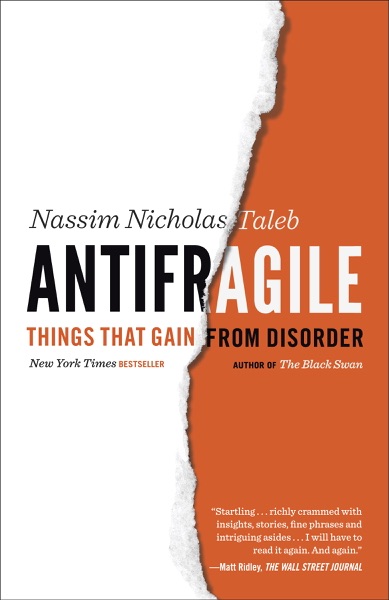
Antifragile
by Nassim Taleb
📖 About the book
Antifragile by Nassim Nicholas Taleb, published in 2012, serves as the practical application of the theories introduced in The Black Swan. Taleb argues that robustness or resilience is not enough in a volatile world. To truly succeed, an organization or individual must be Antifragile—actually benefiting from shocks, stressors, and disorder. This provocative work provides a blueprint for building systems that improve under pressure, fundamentally changing the approach to everything from innovation to healthcare and economic policy.
The core concept is the Antifragility Triad: Fragile (hates volatility), Robust (indifferent to volatility), and Antifragile (loves volatility). Taleb emphasizes the importance of Optionality, where having more choices allows one to capitalize on positive randomness with limited downside. He advocates for Skin in the Game, arguing that systems only remain healthy when decision-makers share the risk of failure. He also introduces 'Via Negativa'—the idea that growth and health are often achieved by removing things rather than adding them.
Essential for entrepreneurs, engineers, and risk managers seeking a competitive edge in uncertain times. Readers gain value by learning how to design organizations that thrive during market crashes or industry disruptions. Real-world applications include encouraging Trial and Error (which has optionality) over rigid top-down planning and decentralizing power to increase systemic agility. By embracing antifragility, leaders can stop fearing the unknown and start leveraging the inevitable chaos of the modern world to drive superior long-term results.
💡 Key takeaways
Seek out Optionality in your strategic planning, ensuring you have the ability to capitalize on favorable market shifts without being committed to a single path.
Practice Via Negativa by identifying and removing fragile components—such as excessive debt or centralized bottlenecks—to strengthen your organization's core.
Require Skin in the Game for all key decision-makers to ensure that their personal incentives are aligned with the long-term health and survival of the system.
❓ FAQ
Is "Antifragile" by Nassim Taleb free to download?
Yes. BookHubs provides a free preview for "Antifragile". For the full legal text we link to OpenLibrary (Internet Archive), which is also free to read.
What is "Antifragile" about?
Download the guide to thriving in chaos for free. Learn how to build systems that actually get stronger under pressure and volatility.
How long does it take to read "Antifragile"?
At an average reading pace of ~250 words per minute, "Antifragile" (519 pages) takes roughly 779 minutes — about 13.0 hours. The 3 key takeaways on this page cover the core ideas in under 5 minutes.
What is the ISBN of "Antifragile"?
The ISBN of "Antifragile" by Nassim Taleb is 978-1400067824, published by Random House.
📚 Related books
All books →
7 Habits of Highly Effective People
Stephen Covey

High Output Management
Andrew Grove

The Righteous Mind
Jonathan Haidt

Business Model Generation
Osterwalder, Pigneur

Management
Peter Drucker

Out of the Crisis
W. Edwards Deming