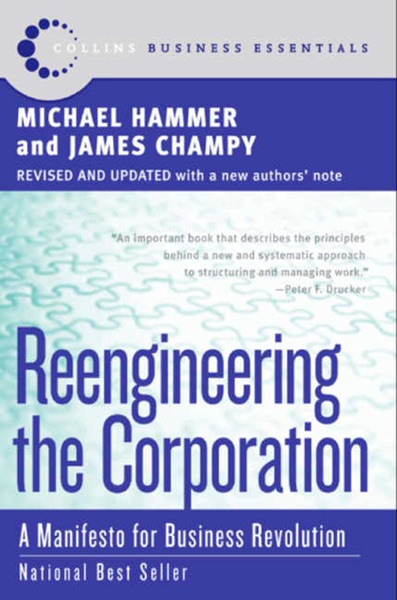
Reengineering the Corporation
by Michael Hammer, James Champy
📖 About the book
Reengineering the Corporation by Michael Hammer and James Champy, published in 1993, sparked a massive movement in the business world by challenging the foundational assumptions of the Industrial Revolution. The authors argue that modern companies are bogged down by outdated, task-oriented structures established by Adam Smith and Henry Ford. To survive in a competitive, fast-paced global economy, organizations must abandon incremental improvements and instead radically redesign their core processes from the ground up.
The central methodology is Business Process Reengineering (BPR), defined as the fundamental rethinking and radical redesign of business processes to achieve dramatic improvements in critical performance measures like cost, quality, service, and speed. The book advocates moving away from a functional silos (e.g., marketing, manufacturing) toward a Process-Oriented Structure where cross-functional teams manage entire workflows from start to finish. The authors also emphasize the critical role of Information Technology not merely to automate old processes, but as an enabler to create entirely new ways of working.
Essential for operations managers, CIOs, and executives leading organizational change, this book provides a blueprint for radical transformation. Readers gain the tools to identify and eliminate non-value-adding tasks that slow down delivery and inflate costs. Real-world applications include mapping the "order-to-delivery" process to eliminate hand-offs and utilizing shared databases to empower frontline workers to make decisions. By embracing reengineering, companies can achieve quantum leaps in performance rather than settling for marginal gains.
💡 Key takeaways
Initiate Business Process Reengineering (BPR) by starting with a clean slate and asking, "If we were recreating this company today, how would we operate?"
Transition from departmental silos to a Process-Oriented Structure, empowering cross-functional teams to manage entire workflows to drastically reduce delays and errors.
Leverage modern Information Technology not just to automate existing inefficiencies, but as a catalyst to fundamentally change how work is performed and managed.
❓ FAQ
Is "Reengineering the Corporation" by Michael Hammer, James Champy free to download?
Yes. BookHubs provides a free preview for "Reengineering the Corporation". For the full legal text we link to OpenLibrary (Internet Archive), which is also free to read.
What is "Reengineering the Corporation" about?
Download Reengineering the Corporation for free. A manifesto for business revolution, teaching how to radically redesign processes for dramatic improvements.
How long does it take to read "Reengineering the Corporation"?
At an average reading pace of ~250 words per minute, "Reengineering the Corporation" (272 pages) takes roughly 408 minutes — about 6.8 hours. The 3 key takeaways on this page cover the core ideas in under 5 minutes.
What is the ISBN of "Reengineering the Corporation"?
The ISBN of "Reengineering the Corporation" by Michael Hammer, James Champy is 978-0060559533, published by HarperBusiness.
📚 Related books
All books →
7 Habits of Highly Effective People
Stephen Covey

High Output Management
Andrew Grove

The Righteous Mind
Jonathan Haidt

Antifragile
Nassim Taleb

Business Model Generation
Osterwalder, Pigneur

Management
Peter Drucker