Playing to Win
📖 About the book
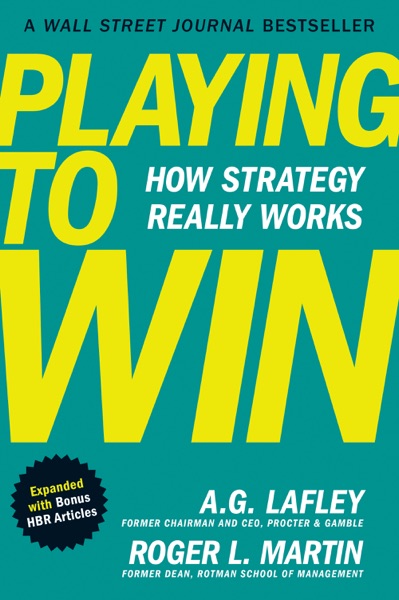
Playing to Win by A.G. Lafley and Roger Martin, published in 2013, is a masterclass in strategy based on one of the most successful corporate turnarounds in history. Lafley, the former CEO of Procter & Gamble, and Martin, his long-time advisor, share the framework they used to double P&G's sales and quadruple its profits. The book challenges the idea that strategy is a mysterious art, providing instead a Disciplined Logic for making the five essential choices that lead to market leadership in any industry.
The framework centers on the Five Choices Framework: Winning Aspiration, Where to Play, How to Win, Core Capabilities, and Management Systems. The authors emphasize that strategy is about 'winning,' not just 'playing' or 'participating.' They introduce the concept of the Strategic Logic Flow to pressure-test choices by asking, 'What would have to be true for this strategy to be a great one?' This process helps teams identify and mitigate the risks associated with market entry, pricing, and competitive response before committing significant capital.
Essential for brand managers, executives, and entrepreneurs seeking a repeatable process for success. Readers gain value by learning how to align their organization around a Clear Strategic Narrative that everyone can understand and execute. Real-world applications include redefining product categories to find 'uncontested' growth and building the specific Institutional Capabilities required to sustain a competitive edge. By applying the P&G model, leaders can transform their strategic planning from a bureaucratic chore into a powerful engine for value creation and sustainable growth.
💡 Key takeaways
Define a clear Winning Aspiration that sets an ambitious goal for your organization, ensuring that everyone understands that the objective is leadership, not just participation.
Determine your Where to Play boundaries by identifying the specific geographies, customer segments, and channels where you have a structural advantage over your competitors.
Pressure-test your strategy by asking 'What Would Have to Be True?' to identify the critical assumptions and market conditions required for your plan to succeed.
❓ FAQ
Is "Playing to Win" by A.G. Lafley, Roger Martin free to download?
Yes. BookHubs provides a free preview for "Playing to Win". For the full legal text we link to OpenLibrary (Internet Archive), which is also free to read.
What is "Playing to Win" about?
Download the definitive guide to strategy for free. Learn the framework used by P&G to double profits and dominate global consumer markets.
How long does it take to read "Playing to Win"?
At an average reading pace of ~250 words per minute, "Playing to Win" (272 pages) takes roughly 408 minutes — about 6.8 hours. The 3 key takeaways on this page cover the core ideas in under 5 minutes.
What is the ISBN of "Playing to Win"?
The ISBN of "Playing to Win" by A.G. Lafley, Roger Martin is 978-1422160596, published by Harvard Business Review Press.
📚 Related books
All books →
7 Habits of Highly Effective People
Stephen Covey

High Output Management
Andrew Grove

The Righteous Mind
Jonathan Haidt

Antifragile
Nassim Taleb

Business Model Generation
Osterwalder, Pigneur

Management
Peter Drucker