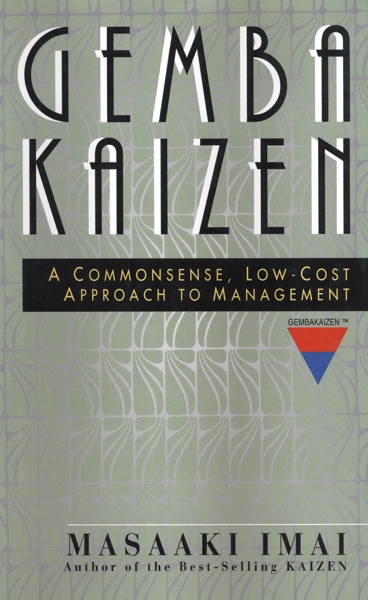
Gemba Kaizen
by Masaaki Imai
📖 About the book
Gemba Kaizen by Masaaki Imai, published in 1997, is the practical, hands-on follow-up to his original classic on Kaizen. Imai focuses on the Gemba—the 'actual place' where work is performed and value is created. He argues that management's biggest mistake is being disconnected from the reality of the shop floor or the frontline service desk. This book provides a common-sense, low-cost approach to management that prioritizes direct observation and immediate action over complex analytical models.
The book details the Three Pillars of Gemba Management: Housekeeping (5S), Muda (Waste) Elimination, and Standardization. Imai explains that by maintaining a clean, organized, and standardized workplace, an organization can surface problems immediately. He emphasizes Visual Management, ensuring that the status of any process is obvious to anyone walking through the Gemba. The framework stresses that any improvement must be anchored in Standard Work; otherwise, the organization will eventually regress to its old, inefficient habits.
Essential for department leads, plant managers, and service supervisors. Readers gain concrete value by learning how to achieve dramatic productivity gains without expensive technology or large capital investments. Practical applications include conducting Gemba Walks to engage with employees and implementing '5S' programs to optimize the physical workspace. By mastering Gemba Kaizen, leaders can transform the workplace into a highly efficient, self-correcting environment where quality is maintained through the collective discipline of the entire team.
💡 Key takeaways
Prioritize Gemba Walks, requiring managers to spend significant time at the actual place where value is created to understand operational reality firsthand.
Implement the 5S Framework (Sort, Set in order, Shine, Standardize, Sustain) to create an organized workplace where inefficiencies and defects are instantly visible.
Eliminate the Muda of Waiting and Motion by redesigning the physical layout of the Gemba to minimize unnecessary movement and optimize the flow of work.
❓ FAQ
Is "Gemba Kaizen" by Masaaki Imai free to download?
Yes. BookHubs provides a free preview for "Gemba Kaizen". For the full legal text we link to OpenLibrary (Internet Archive), which is also free to read.
What is "Gemba Kaizen" about?
Download the guide to workplace improvement for free. Learn how to achieve low-cost, high-impact results by focusing on the 'Gemba'—the actual place of work.
How long does it take to read "Gemba Kaizen"?
At an average reading pace of ~250 words per minute, "Gemba Kaizen" (354 pages) takes roughly 531 minutes — about 8.8 hours. The 3 key takeaways on this page cover the core ideas in under 5 minutes.
What is the ISBN of "Gemba Kaizen"?
The ISBN of "Gemba Kaizen" by Masaaki Imai is 978-0071343152, published by McGraw-Hill.
📚 Related books
All books →
7 Habits of Highly Effective People
Stephen Covey

High Output Management
Andrew Grove

The Righteous Mind
Jonathan Haidt

Antifragile
Nassim Taleb

Business Model Generation
Osterwalder, Pigneur

Management
Peter Drucker