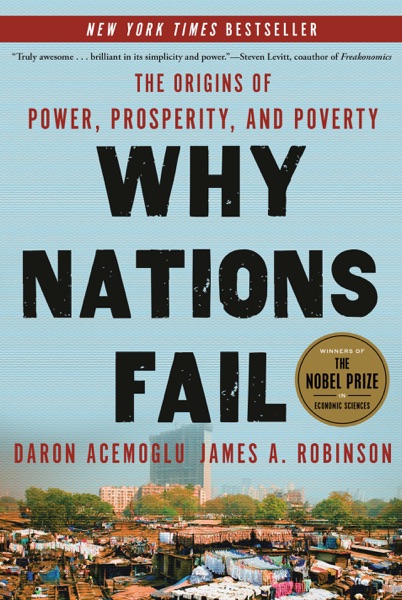
Why Nations Fail
by Daron Acemoglu, James Robinson
📖 About the book
Why Nations Fail: The Origins of Power, Prosperity, and Poverty by Daron Acemoglu and James A. Robinson, published in 2012, provides a rigorous Institutional Framework for understanding economic growth. The authors argue that the primary driver of success is not geography or culture, but Inclusive Institutions—political and economic systems that distribute power widely and encourage innovation. This book fundamentally changes how leaders view the relationship between Law, Property Rights, and Strategic Investment.
The core methodology centers on the distinction between Inclusive and Extractive Institutions. Extractive institutions are designed to strip wealth from the many for the benefit of the few, leading to inevitable stagnation and failure. The authors explain the importance of Creative Destruction and detail why elites often block innovation to protect their own status. He introduces the concept of the Critical Junctures—pivotal historical moments that set a society on a path toward success or decline. The focus is on building Pluralistic Organizations that foster long-term stability.
Essential reading for policy makers, global CEOs, and development experts. Readers gain concrete value by learning how to diagnose the Systemic Health of a market before entry. Practical applications include utilizing 'Incentive Alignment Audits' and redesigning Corporate Governance to prevent extractive management styles. By mastering the logic of Acemoglu and Robinson, leaders can build organizations and societies that are structurally more innovative and resilient to the 'Iron Law of Oligarchy.'
💡 Key takeaways
Foster Inclusive Organizational Structures that encourage meritocracy and distribute influence, recognizing that broad participation is the primary driver of long-term innovation.
Beware of Extractive Leadership patterns, where short-term gains for the executive team are achieved at the cost of the organization's long-term strategic health and employee motivation.
Identify Critical Junctures in your industry’s history, recognizing that small, courageous strategic choices during periods of chaos can determine your firm's trajectory for decades.
❓ FAQ
Is "Why Nations Fail" by Daron Acemoglu, James Robinson free to download?
Yes. BookHubs provides a free preview for "Why Nations Fail". For the full legal text we link to OpenLibrary (Internet Archive), which is also free to read.
What is "Why Nations Fail" about?
Free download of the guide to the origins of power. Learn the difference between Inclusive and Extractive institutions with Acemoglu and Robinson.
How long does it take to read "Why Nations Fail"?
At an average reading pace of ~250 words per minute, "Why Nations Fail" (544 pages) takes roughly 816 minutes — about 13.6 hours. The 3 key takeaways on this page cover the core ideas in under 5 minutes.
What is the ISBN of "Why Nations Fail"?
The ISBN of "Why Nations Fail" by Daron Acemoglu, James Robinson is 978-0307719218, published by Crown Business.
📚 Related books
All books →
7 Habits of Highly Effective People
Stephen Covey

High Output Management
Andrew Grove

The Righteous Mind
Jonathan Haidt

Antifragile
Nassim Taleb

Business Model Generation
Osterwalder, Pigneur

Management
Peter Drucker