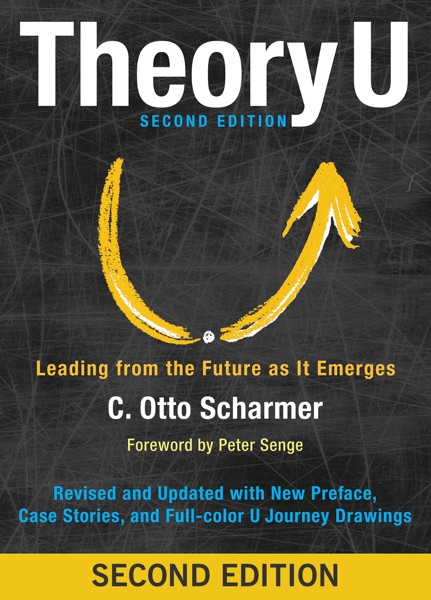
Theory U
📖 About the book
Theory U: Leading from the Future as It Emerges by Otto Scharmer, published in 2007, introduces a revolutionary framework for leading in a world of profound uncertainty and rapid change. Scharmer, a senior lecturer at MIT, argues that our traditional ways of learning—based on past experience—are no longer sufficient for solving 21st-century problems. This book provides a methodology for leaders to tap into a deeper level of awareness, allowing them to perceive and actualize future possibilities before they become obvious trends.
The central framework is the U-Process, which takes leaders through five stages: Co-initiating, Co-sensing, Presencing, Co-creating, and Co-evolving. The core concept of 'Presencing'—a blend of presence and sensing—requires leaders to 'open their minds, hearts, and wills' to drop old mental models and connect with their highest future potential. Scharmer details the Four Levels of Listening and the importance of 'holding the space' for collective innovation. The focus is on shifting the 'inner place' from which we operate to create more sustainable and inclusive organizations.
This is mandatory reading for visionaries, change agents, and senior executives in the social and corporate sectors. Readers gain concrete value by learning how to facilitate Deep Innovation sessions that move beyond surface-level brainstorming. Practical applications include utilizing Generative Dialogue to resolve complex conflicts and using 'prototyping' to rapidly test emerging solutions. By mastering Theory U, leaders can move from reactive management to a proactive style that is deeply aligned with the emerging needs of the global community.
💡 Key takeaways
Navigate the U-Process to move beyond reactive decision-making and learn to lead from 'the future as it emerges' rather than relying on past data.
Practice Presencing by quieting your inner voice of judgment and opening your mind and heart to perceive deep systemic patterns and hidden opportunities.
Utilize the Four Levels of Listening—from downloading facts to generative listening—to foster a creative environment where collective intelligence can solve your toughest strategic challenges.
❓ FAQ
Is "Theory U" by Otto Scharmer free to download?
Yes. BookHubs provides a free preview for "Theory U". For the full legal text we link to OpenLibrary (Internet Archive), which is also free to read.
What is "Theory U" about?
Download the guide to leading from the future for free. Learn Otto Scharmer's U-process to drive profound innovation and organizational change.
How long does it take to read "Theory U"?
At an average reading pace of ~250 words per minute, "Theory U" (533 pages) takes roughly 800 minutes — about 13.3 hours. The 3 key takeaways on this page cover the core ideas in under 5 minutes.
What is the ISBN of "Theory U"?
The ISBN of "Theory U" by Otto Scharmer is 978-1576753309, published by Berrett-Koehler Publishers.
📚 Related books
All books →
7 Habits of Highly Effective People
Stephen Covey

High Output Management
Andrew Grove

The Righteous Mind
Jonathan Haidt

Antifragile
Nassim Taleb

Business Model Generation
Osterwalder, Pigneur

Management
Peter Drucker