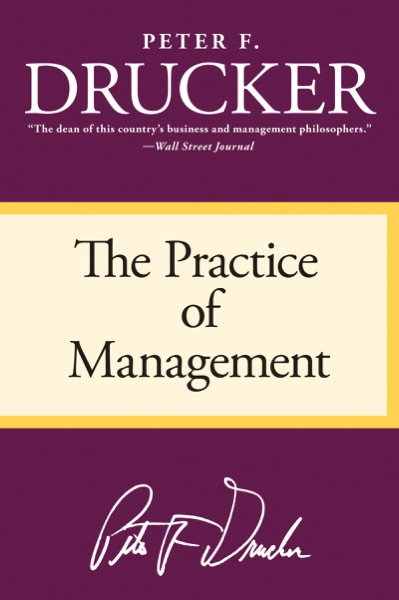
The Practice of Management
📖 About the book
The Practice of Management by Peter Drucker, published in 1954, is the book that created the modern discipline of management. Before this work, management was often seen as a collection of tricks or a matter of charisma; Drucker established it as a distinct function, a separate work, and a primary social responsibility. This classic text laid the groundwork for how we understand the corporation, the role of the manager, and the relationship between business and society, making it mandatory reading for any serious student of leadership.
Drucker introduces the revolutionary concept of Management by Objectives (MBO), where managers and employees agree on specific goals to ensure everyone is pulling in the same direction. He defines the three primary tasks of management: managing a business, managing managers, and managing workers and work. He famously asks the two most important questions in business: "What is our business?" and "What should it be?" By focusing on Innovation and Marketing as the two basic functions of any enterprise, Drucker provides a timeless framework for organizational survival and growth.
This book is a cornerstone for CEOs, HR directors, and entrepreneurs. Readers gain value by learning how to structure an organization around performance rather than hierarchy. Real-world applications include implementing MBO Systems to improve accountability and utilizing Drucker's five basic operations of a manager—setting objectives, organizing, motivating, measuring, and developing people. By practicing these principles, leaders can create an environment where individual efforts compound into significant organizational achievement and long-term market relevance.
💡 Key takeaways
Implement Management by Objectives (MBO) to align the individual goals of employees with the strategic priorities of the entire corporation, ensuring unified effort.
Continually reassess your market position by answering Drucker's core strategic questions: "What is our business?" and "What should it be in the future?"
Focus your organization on the two basic functions that create value: Marketing and Innovation, treating all other business activities as support for these drivers.
❓ FAQ
Is "The Practice of Management" by Peter Drucker free to download?
Yes. BookHubs provides a free preview for "The Practice of Management". For the full legal text we link to OpenLibrary (Internet Archive), which is also free to read.
What is "The Practice of Management" about?
Download The Practice of Management for free. Discover the foundational principles of management, including MBO, from the father of management theory.
How long does it take to read "The Practice of Management"?
At an average reading pace of ~250 words per minute, "The Practice of Management" (416 pages) takes roughly 624 minutes — about 10.4 hours. The 3 key takeaways on this page cover the core ideas in under 5 minutes.
What is the ISBN of "The Practice of Management"?
The ISBN of "The Practice of Management" by Peter Drucker is 978-0060110956, published by Harper & Brothers.
📚 Related books
All books →
7 Habits of Highly Effective People
Stephen Covey

High Output Management
Andrew Grove

The Righteous Mind
Jonathan Haidt

Antifragile
Nassim Taleb

Business Model Generation
Osterwalder, Pigneur

Management
Peter Drucker