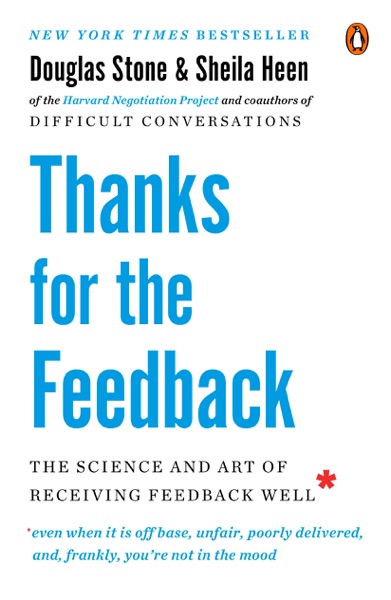
Thanks for the Feedback
📖 About the book
Thanks for the Feedback by Douglas Stone and Sheila Heen, published in 2014, addresses a fundamental imbalance in management: the focus on *giving* feedback rather than *receiving* it. The authors argue that the key to Organizational Learning lies with the receiver, who determines what information to accept or reject. This work provides a rigorous framework for individuals to navigate the emotional and cognitive challenges of being evaluated, coached, or criticized in a high-pressure corporate environment.
The book identifies Three Feedback Triggers—Truth, Relationship, and Identity—that cause us to react defensively. Stone and Heen explain how to dismantle these triggers by distinguishing between Appreciation, Coaching, and Evaluation. They introduce the concept of Switchtracking, where two people in a conversation are actually talking about two different things, and provide techniques for 'Seeing Your Blind Spots.' The focus is on moving from 'Defensiveness' toward Growth Mindset, where every piece of data is treated as a potential source of competitive advantage.
This is mandatory reading for anyone in a professional development role or anyone seeking to improve their personal effectiveness. Readers gain value by learning how to extract the 'gold' from poorly delivered criticism. Practical applications include utilizing Feedforward Sessions to focus on future behavior and redesigning Performance Reviews to align expectations between the giver and the receiver. By mastering the art of receiving feedback, leaders can accelerate their own growth and foster a more resilient, learning-oriented organizational culture.
💡 Key takeaways
Recognize your Identity Triggers to manage the emotional shock that often follows critical evaluation, allowing you to process feedback more objectively and strategically.
Distinguish between Coaching and Evaluation to ensure you are receiving the right type of information for your current professional needs and goals.
Avoid Switchtracking by staying focused on the giver’s specific feedback before introducing your own concerns about the relationship or the delivery method.
❓ FAQ
Is "Thanks for the Feedback" by Douglas Stone, Sheila Heen free to download?
Yes. BookHubs provides a free preview for "Thanks for the Feedback". For the full legal text we link to OpenLibrary (Internet Archive), which is also free to read.
What is "Thanks for the Feedback" about?
Free download of the guide to the science of receiving feedback. Learn how to learn from criticism and praise even when it is poorly delivered.
How long does it take to read "Thanks for the Feedback"?
At an average reading pace of ~250 words per minute, "Thanks for the Feedback" (368 pages) takes roughly 552 minutes — about 9.2 hours. The 3 key takeaways on this page cover the core ideas in under 5 minutes.
What is the ISBN of "Thanks for the Feedback"?
The ISBN of "Thanks for the Feedback" by Douglas Stone, Sheila Heen is 978-0141977256, published by Penguin Books.
📚 Related books
All books →
Atomic Habits
James Clear

Can't Hurt Me
David Goggins

Ego Is the Enemy
Ryan Holiday

Influence
Robert Cialdini

Man's Search for Meaning
Viktor Frankl

Never Split the Difference
Chris Voss