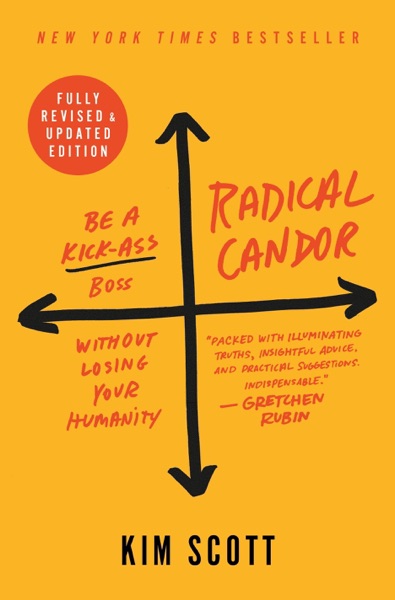
Radical Candor
by Kim Scott
📖 About the book
Radical Candor by Kim Scott, published in 2017, provides a revolutionary framework for effective management based on her experiences at Google and Apple. Scott argues that the best bosses build strong relationships by doing two things simultaneously: Caring Personally and Challenging Directly. This book serves as a practical manual for leaders to eliminate the toxic cultures of 'ruinous empathy' or 'manipulative insincerity' and replace them with a high-performance environment built on honesty.
The core methodology centers on the Radical Candor Matrix, which categorizes management styles based on the balance of care and challenge. Scott introduces the Get-Give-Gauge-Encourage cycle for feedback and emphasizes the importance of Guidance over control. She details how to build a 'culture of listening' and provides frameworks for Performance Management that prioritize growth and accountability. The focus is on creating a workplace where feedback is a gift, intended to help everyone achieve their best potential.
This is mandatory reading for team leads, CEOs, and HR professionals looking to drive organizational excellence. Readers gain concrete value by learning how to give difficult feedback without being a jerk. Practical applications include utilizing Impromptu Guidance sessions and redesigning career development paths to focus on 'rockstars' and 'superstars' differently. By applying Radical Candor, leaders can foster deep loyalty and drive superior strategic results through a culture of courageous and kind communication.
💡 Key takeaways
Apply the Radical Candor Matrix to evaluate your leadership style, ensuring you are challenging your team directly while maintaining a high level of personal care.
Eliminate Ruinous Empathy by having the courage to provide honest, critical feedback that helps your employees grow, rather than avoiding conflict to protect feelings.
Foster a Culture of Guidance where feedback is given and received in real-time, reducing the need for bureaucratic annual reviews and increasing team agility.
❓ FAQ
Is "Radical Candor" by Kim Scott free to download?
Yes. BookHubs provides a free preview for "Radical Candor". For the full legal text we link to OpenLibrary (Internet Archive), which is also free to read.
What is "Radical Candor" about?
Free download of Radical Candor by Kim Scott. Learn how to be a 'kickass boss' by caring personally while challenging your team directly.
How long does it take to read "Radical Candor"?
At an average reading pace of ~250 words per minute, "Radical Candor" (272 pages) takes roughly 408 minutes — about 6.8 hours. The 3 key takeaways on this page cover the core ideas in under 5 minutes.
What is the ISBN of "Radical Candor"?
The ISBN of "Radical Candor" by Kim Scott is 978-1250103505, published by St. Martin's Press.
📚 Related books
All books →
The 21 Irrefutable Laws of Leadership
John Maxwell

Dare to Lead
Brené Brown

How to Win Friends and Influence People
Dale Carnegie

Shoe Dog
Phil Knight

The Laws of Human Nature
Robert Greene

Think Again
Adam Grant