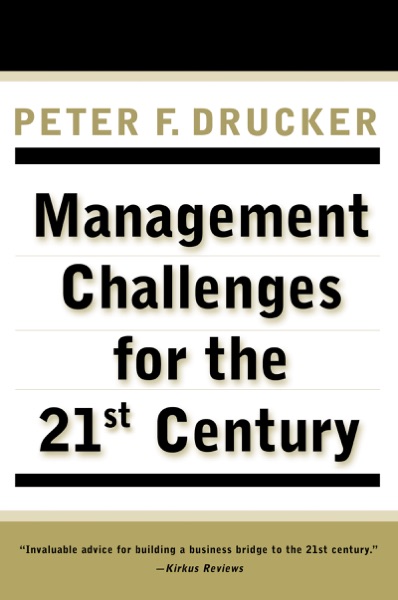
Management Challenges for the 21st Century
📖 About the book
Management Challenges for the 21st Century by Peter Drucker, published in 1999, is a prophetic work that identified the massive tectonic shifts that would define our current era. Drucker challenges the management assumptions of the 20th century, arguing that they are no longer valid in a world characterized by global competition and a rapidly aging workforce. This book serves as a vital survival guide for leaders navigating the transition from a society based on manual labor to one driven by knowledge and information.
Drucker highlights the critical importance of Managing Oneself, arguing that in a knowledge economy, individuals must take responsibility for their own development and career paths. He discusses the impact of Global Competitiveness and the need for organizations to look beyond their own industries and countries for both opportunities and threats. A major theme is the New Demographics, specifically the falling birth rates in developed nations, and how this will fundamentally alter labor markets. He also emphasizes The Next Society, where information technology is only the enabler for even deeper social and economic changes.
This book is essential for strategic planners, policy makers, and individual professionals. Readers gain value by learning how to anticipate long-term social trends that will impact their business models. Real-world applications include developing Personal Productivity Plans and restructuring HR policies to accommodate an older, more mobile workforce. By understanding these 21st-century challenges, leaders can position their organizations to thrive in an era of unprecedented demographic and technological change, ensuring they are not left behind by the future.
💡 Key takeaways
Take total responsibility for Managing Oneself by identifying your unique strengths, values, and optimal work methods to thrive in a decentralized knowledge economy.
Prepare for Global Competitiveness by systematically analyzing international market trends and demographic shifts that could disrupt your domestic business model.
Redesign your organization to improve Knowledge Worker Productivity, focusing on the quality of output and continuous learning rather than mere hours spent at a desk.
❓ FAQ
Is "Management Challenges for the 21st Century" by Peter Drucker free to download?
Yes. BookHubs provides a free preview for "Management Challenges for the 21st Century". For the full legal text we link to OpenLibrary (Internet Archive), which is also free to read.
What is "Management Challenges for the 21st Century" about?
Download Peter Drucker's prophetic guide to 21st-century management for free. Prepare for the shifts in demographics and the knowledge economy.
How long does it take to read "Management Challenges for the 21st Century"?
At an average reading pace of ~250 words per minute, "Management Challenges for the 21st Century" (224 pages) takes roughly 336 minutes — about 5.6 hours. The 3 key takeaways on this page cover the core ideas in under 5 minutes.
What is the ISBN of "Management Challenges for the 21st Century"?
The ISBN of "Management Challenges for the 21st Century" by Peter Drucker is 978-0060191610, published by HarperBusiness.
📚 Related books
All books →
7 Habits of Highly Effective People
Stephen Covey

High Output Management
Andrew Grove

The Righteous Mind
Jonathan Haidt

Antifragile
Nassim Taleb

Business Model Generation
Osterwalder, Pigneur

Management
Peter Drucker