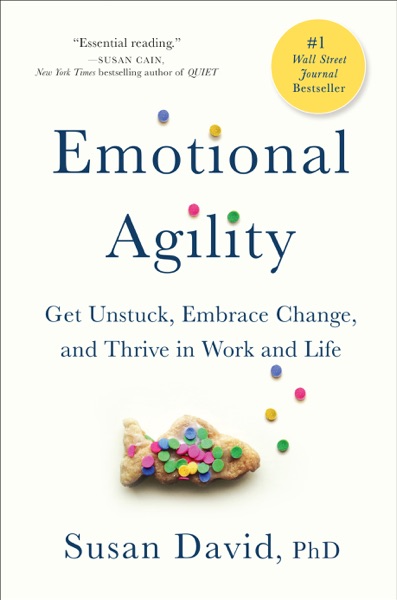
Emotional Agility
by Susan David
📖 About the book
Emotional Agility: Get Unstuck, Embrace Change, and Thrive in Work and Life by Dr. Susan David, published in 2016, is a rigorous challenge to the 'cult of positivity.' David, a Harvard psychologist, argues that suppressing negative emotions actually decreases resilience and creativity. This book provides a framework for Emotional Agility—the ability to be with our thoughts and feelings in a way that isn't driven by them, but rather informed by them to make better strategic choices in high-pressure environments.
The core methodology identifies Four Essential Movements: Showing Up (facing emotions), Stepping Out (detaching), Walking Your Why (aligning with values), and Moving On (acting). David explains the concept of Emotional Hooking—when we allow a single thought or feeling to dictate our behavior—and provide techniques for 'labeling' emotions to reduce their power. The focus is on building Psychological Flexibility, where individuals use their inner experience as data points rather than directives, ensuring that their actions remain consistent with their long-term professional goals.
This is crucial reading for managers, creative leads, and anyone navigating large-scale organizational change. Readers gain value by learning how to lead with Authentic Vulnerability. Practical applications include utilizing 'Values-Driven Goal Setting' and implementing 'non-judgmental feedback' loops. By mastering emotional agility, leaders can build organizations that are more resilient, ethical, and innovative, where the diverse emotional experiences of the workforce are leveraged for deeper insight and strategic growth.
💡 Key takeaways
Practice Emotional Labeling to identify and name your specific feelings, which immediately reduces the stress response and allows for more objective strategic decision-making.
Cultivate Psychological Flexibility by distancing yourself from your thoughts, recognizing them as data to be evaluated rather than absolute truths that must be acted upon.
Ensure all your professional actions are Values-Aligned, using your core principles as the compass to navigate difficult organizational pivots and market transitions.
❓ FAQ
Is "Emotional Agility" by Susan David free to download?
Yes. BookHubs provides a free preview for "Emotional Agility". For the full legal text we link to OpenLibrary (Internet Archive), which is also free to read.
What is "Emotional Agility" about?
Free download of Susan David's guide to emotional intelligence. Learn how to unhook from difficult thoughts and lead with clarity and purpose.
How long does it take to read "Emotional Agility"?
At an average reading pace of ~250 words per minute, "Emotional Agility" (288 pages) takes roughly 432 minutes — about 7.2 hours. The 3 key takeaways on this page cover the core ideas in under 5 minutes.
What is the ISBN of "Emotional Agility"?
The ISBN of "Emotional Agility" by Susan David is 978-1594633645, published by Avery.
📚 Related books
All books →
Atomic Habits
James Clear

Can't Hurt Me
David Goggins

Ego Is the Enemy
Ryan Holiday

Influence
Robert Cialdini

Man's Search for Meaning
Viktor Frankl

Never Split the Difference
Chris Voss