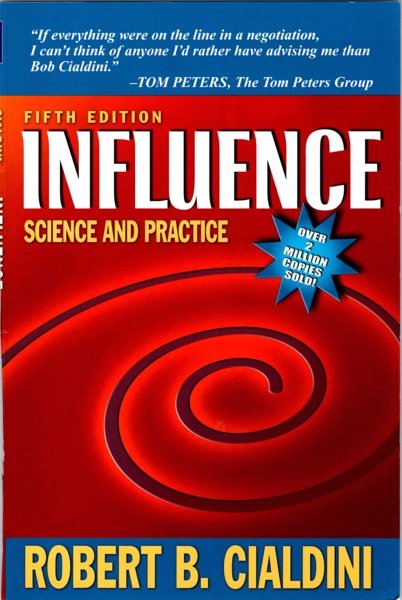
Influence
📖 About the book
Influence: The Psychology of Persuasion by Robert Cialdini, published in 1984, is a cornerstone text for both marketing and leadership. Cialdini, a social psychologist, argues that our decision-making is often driven by automatic, evolutionary shortcuts. This book provides a rigorous framework for understanding Social Influence, identifying the specific 'weapons of persuasion' that can be used to move individuals and masses toward a desired action, fundamentally changing how we view communication and strategic choice.
The core methodology centers on the Six Principles of Influence: Reciprocity, Commitment & Consistency, Social Proof, Liking, Authority, and Scarcity. Cialdini explains the science of the Contrast Principle and providing numerous case studies on how these principles are applied in sales, negotiation, and fundraising. He details the importance of 'Mental Triggers' and provides techniques for 'ethical persuasion.' The focus is on recognizing these patterns to both utilize them for organizational growth and to defend against their manipulative use by competitors.
This book is mandatory reading for marketing directors, sales leads, and senior negotiators. Readers gain concrete value by learning how to structure their messaging for maximum Persuasive Impact. Practical applications include utilizing Social Proof in customer testimonials and redesigning product launches to leverage Scarcity and Exclusivity. By internalizing Cialdini’s principles, leaders can ensure that their strategic communications are psychologically optimized, driving higher conversion rates and stronger professional rapport across all market interactions.
💡 Key takeaways
Apply the Reciprocity Principle by providing value to your stakeholders first, creating a psychological obligation that significantly increases your future persuasive power.
Leverage Social Proof by highlighting the endorsements of your existing customers and industry leaders to reduce perceived risk for new strategic partners.
Utilize Commitment and Consistency by asking for small, initial agreements that lead your stakeholders to stay aligned with your larger organizational goals over time.
❓ FAQ
Is "Influence" by Robert Cialdini free to download?
Yes. BookHubs provides a free preview for "Influence". For the full legal text we link to OpenLibrary (Internet Archive), which is also free to read.
What is "Influence" about?
Free download of the definitive guide to persuasion. Master the 6 Principles of Influence to drive marketing success and personal professional impact.
How long does it take to read "Influence"?
At an average reading pace of ~250 words per minute, "Influence" (320 pages) takes roughly 480 minutes — about 8.0 hours. The 3 key takeaways on this page cover the core ideas in under 5 minutes.
What is the ISBN of "Influence"?
The ISBN of "Influence" by Robert Cialdini is 978-0688128166, published by William Morrow.
📚 Related books
All books →
Atomic Habits
James Clear

Can't Hurt Me
David Goggins

Ego Is the Enemy
Ryan Holiday

Man's Search for Meaning
Viktor Frankl

Never Split the Difference
Chris Voss

The Psychology of Money
Morgan Housel