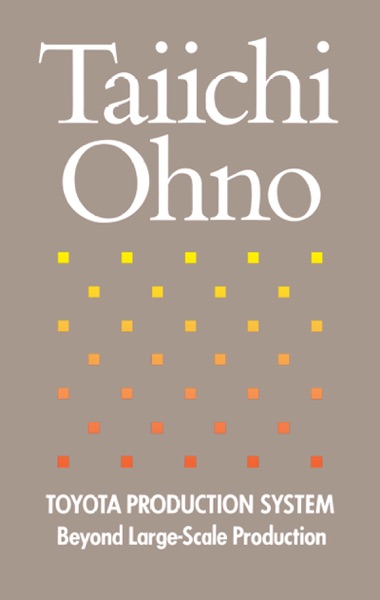
Toyota Production System
by Taiichi Ohno
📖 About the book
Toyota Production System: Beyond Large-Scale Production by Taiichi Ohno, published in its English translation in 1988, is the original source text for what we now call Lean manufacturing. Ohno, the former executive vice president of Toyota, describes his quest to help the company survive in a resource-scarce post-war Japan. By rejecting the mass production models of Henry Ford and General Motors, Ohno created a revolutionary system based on Waste Elimination and total efficiency that allowed Toyota to produce a wide variety of cars with minimal resources.
The book introduces the foundational pillars of TPS (Toyota Production System): Just-in-Time (JIT) and Jidoka (autonomation). Ohno describes the Seven Wastes (Muda)—overproduction, waiting, transporting, processing, inventory, motion, and making defective products—and provides the logic for the Kanban System to control the flow of materials. He emphasizes the 'Pull' system, where production is triggered by customer demand rather than forecasted 'Push' schedules, ensuring that only what is needed, when it is needed, is produced.
Essential reading for industrial engineers, operations leaders, and students of management history. Readers gain unparalleled insight into the origins of the world's most influential production philosophy. Practical applications include utilizing the Five Whys to find the root cause of defects and implementing 'Standard Work' to ensure consistency. By studying Ohno's original vision, leaders can understand the rigorous discipline required to build an Efficiency-Driven Culture that can withstand market volatility and deliver superior quality with lower operational costs.
💡 Key takeaways
Apply the Five Whys technique to every operational failure to dig past surface-level symptoms and identify the systemic root cause of the problem.
Eliminate the Seven Wastes (Muda), with a primary focus on reducing overproduction, which Ohno considers the most dangerous form of organizational inefficiency.
Implement a Just-in-Time (JIT) pull system using Kanban to synchronize production with actual customer demand, drastically reducing inventory and carrying costs.
❓ FAQ
Is "Toyota Production System" by Taiichi Ohno free to download?
Yes. BookHubs provides a free preview for "Toyota Production System". For the full legal text we link to OpenLibrary (Internet Archive), which is also free to read.
What is "Toyota Production System" about?
Download the original blueprint for Lean manufacturing for free. Learn the concepts of JIT and waste elimination from the creator of TPS himself.
How long does it take to read "Toyota Production System"?
At an average reading pace of ~250 words per minute, "Toyota Production System" (176 pages) takes roughly 264 minutes — about 4.4 hours. The 3 key takeaways on this page cover the core ideas in under 5 minutes.
What is the ISBN of "Toyota Production System"?
The ISBN of "Toyota Production System" by Taiichi Ohno is 978-0915299140, published by Productivity Press.
📚 Related books
All books →
7 Habits of Highly Effective People
Stephen Covey

High Output Management
Andrew Grove

The Righteous Mind
Jonathan Haidt

Antifragile
Nassim Taleb

Business Model Generation
Osterwalder, Pigneur

Management
Peter Drucker