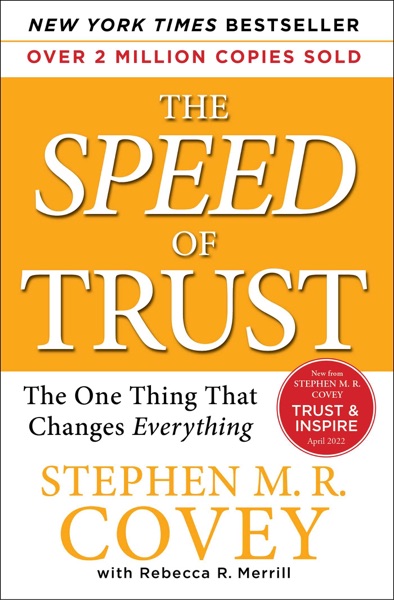
The Speed of Trust
📖 About the book
The Speed of Trust: The One Thing That Changes Everything by Stephen M.R. Covey, published in 2006, challenges the common perception that trust is a 'soft' social virtue. Instead, Covey argues that trust is a Hard Economic Driver—a learnable and measurable skill that directly impacts organizational speed and cost. This work provides a rigorous framework for individuals to build, restore, and leverage trust as their primary competitive advantage in a transparent and hyper-connected global economy.
The core methodology centers on the 5 Waves of Trust: Self Trust, Relationship Trust, Organizational Trust, Market Trust, and Societal Trust. Covey explains that when trust goes up, speed goes up and costs go down (the 'Trust Dividend'), while low trust acts as a 'Trust Tax' on every business transaction. He details the 13 Behaviors of High-Trust Leaders, including 'Talk Straight,' 'Create Transparency,' and 'Right Wrongs.' The focus is on moving from suspicious management to Smart Trust, where leaders use judgment to extend trust to those who earn it.
This is mandatory reading for CEOs, procurement officers, and team leads who need to accelerate project execution. Readers gain value by learning how to identify the hidden 'trust taxes' that slow down their operations. Practical applications include utilizing the Trust Audit for teams and implementing the 13 behaviors to repair damaged professional relationships. By mastering the speed of trust, leaders can build high-performance cultures that are more agile, innovative, and profitable than their low-trust competitors.
💡 Key takeaways
Recognize Trust as an Economic Variable, understanding that increasing organizational trust is the fastest way to reduce the bureaucratic 'taxes' that slow down strategic execution.
Master the 13 Behaviors of High-Trust Leaders, such as 'Practicing Accountability' and 'Delivering Results,' to build a reputation of integrity and competence within your firm.
Implement Smart Trust by balancing a high propensity to trust with rigorous analysis, allowing your organization to be agile without exposing itself to unnecessary risks.
❓ FAQ
Is "The Speed of Trust" by Stephen Covey free to download?
Yes. BookHubs provides a free preview for "The Speed of Trust". For the full legal text we link to OpenLibrary (Internet Archive), which is also free to read.
What is "The Speed of Trust" about?
Free download of the guide to the one thing that changes everything. Learn how high trust increases speed and lowers costs in business and leadership.
How long does it take to read "The Speed of Trust"?
At an average reading pace of ~250 words per minute, "The Speed of Trust" (352 pages) takes roughly 528 minutes — about 8.8 hours. The 3 key takeaways on this page cover the core ideas in under 5 minutes.
What is the ISBN of "The Speed of Trust"?
The ISBN of "The Speed of Trust" by Stephen Covey is 978-1416549000, published by Free Press.
📚 Related books
All books →
The 21 Irrefutable Laws of Leadership
John Maxwell

Dare to Lead
Brené Brown

How to Win Friends and Influence People
Dale Carnegie

Shoe Dog
Phil Knight

The Laws of Human Nature
Robert Greene

Think Again
Adam Grant