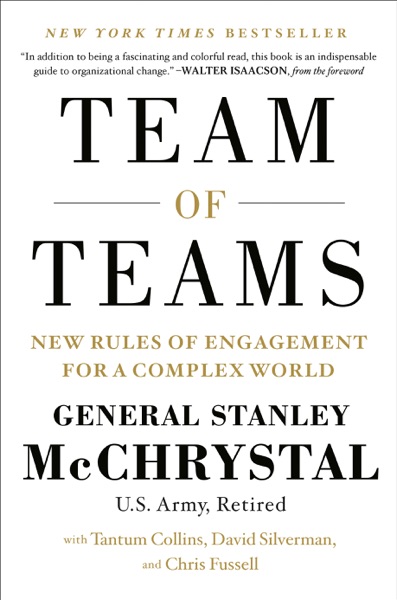
Team of Teams
📖 About the book
Team of Teams by General Stanley McChrystal, published in 2015, addresses the failure of traditional management in a world of high-speed, unpredictable change. Drawing from his experience leading the Joint Special Operations Task Force in Iraq, McChrystal argues that the 20th-century model of 'Efficiency' is no longer sufficient. This book provides a rigorous framework for transforming large, bureaucratic institutions into agile networks capable of surviving in a VUCA (Volatile, Uncertain, Complex, Ambiguous) environment through decentralized authority and extreme transparency.
The core methodology centers on the shift from 'Command and Control' to Shared Consciousness and Empowered Execution. McChrystal explains how to build a Team of Teams by fostering deep trust and common purpose across departmental silos. He introduces the concept of the Leader as Gardener, who focuses on creating the right environment for others to succeed rather than making every tactical decision. The framework emphasizes the need for 'information sharing at scale' and the use of 'Liaison Officers' to create the lateral connections necessary for rapid response and organizational resilience.
This is mandatory reading for senior executives, operations managers, and anyone leading a large-scale digital transformation. Readers gain concrete value by learning how to scale the adaptability of a small team across a global enterprise. Practical applications include implementing Cross-Functional Operations Calls and utilizing the 'Decision-Space' concept to empower frontline employees. By mastering McChrystal’s network-centric logic, leaders can build organizations that are not just efficient, but fundamentally capable of innovating and winning in the most complex competitive landscapes.
💡 Key takeaways
Transition from a Command-and-Control hierarchy to a network of autonomous teams to increase your organization's speed and responsiveness in volatile market conditions.
Cultivate Shared Consciousness by ensuring that critical information is transparently shared across all departments, allowing every team member to understand the total strategic context.
Adopt the Leader-as-Gardener approach, shifting your focus from making tactical decisions to nurturing the organizational culture and removing the barriers that stifle team initiative.
❓ FAQ
Is "Team of Teams" by Stanley McChrystal free to download?
Yes. BookHubs provides a free preview for "Team of Teams". For the full legal text we link to OpenLibrary (Internet Archive), which is also free to read.
What is "Team of Teams" about?
Free download of Team of Teams. Learn General McChrystal's strategies for managing complex organizations with the agility of a small startup.
How long does it take to read "Team of Teams"?
At an average reading pace of ~250 words per minute, "Team of Teams" (304 pages) takes roughly 456 minutes — about 7.6 hours. The 3 key takeaways on this page cover the core ideas in under 5 minutes.
What is the ISBN of "Team of Teams"?
The ISBN of "Team of Teams" by Stanley McChrystal is 978-1591847489, published by Portfolio.
📚 Related books
All books →
The 21 Irrefutable Laws of Leadership
John Maxwell

Dare to Lead
Brené Brown

How to Win Friends and Influence People
Dale Carnegie

Shoe Dog
Phil Knight

The Laws of Human Nature
Robert Greene

Think Again
Adam Grant