The Rise and Fall of Strategic Planning
📖 About the book
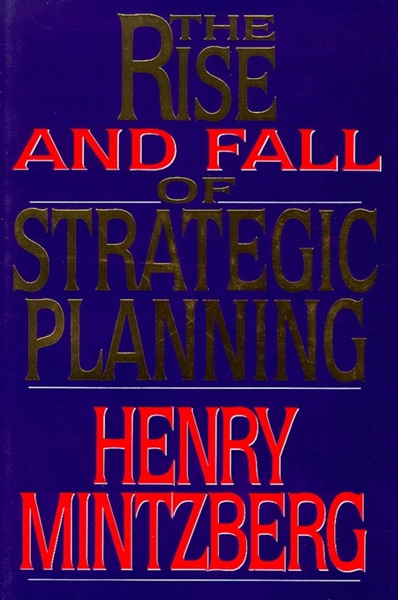
The Rise and Fall of Strategic Planning by Henry Mintzberg, published in 1994, is a provocative and highly influential critique of the traditional corporate planning industry. Mintzberg argues that 'strategic planning' is often a contradiction in terms, as planning is an analytical exercise while strategy creation is a synthetic, creative process. He contends that many organizations fail because they confuse the production of thick planning documents with the actual development of a competitive vision, leading to a disconnect between the boardroom and the reality of the market.
The book identifies the Three Fallacies of Strategic Planning: the fallacy of prediction, the fallacy of detachment, and the fallacy of formalization. Mintzberg distinguishes between Deliberate Strategy (planned) and Emergent Strategy (learning from experience), arguing that successful leaders must be able to embrace both. He emphasizes that strategy cannot be 'calculated' by staff analysts but must be 'crafted' by managers who are deeply involved in the daily life of the organization. The focus is on Strategic Thinking, which involves intuition, creativity, and the ability to see patterns where others see only data.
Essential for CEOs, strategic consultants, and corporate analysts. Readers gain value by learning how to avoid the 'planning trap' and how to foster a more flexible, learning-based approach to strategy. Practical applications include redesigning the Planning Cycle to be more inclusive of frontline insights and utilizing 'strategic retreats' for pattern-recognition rather than just budgeting. By following Mintzberg’s insights, organizations can move beyond rigid, bureaucratic plans and develop a dynamic strategy that is capable of evolving in real-time as the competitive landscape shifts.
💡 Key takeaways
Distinguish between Strategic Planning and Strategic Thinking, ensuring that your organization values creative insight and pattern recognition over formal, data-heavy reporting.
Embrace Emergent Strategy by allowing your team to learn from market experiments and incorporating successful unplanned actions into your official corporate direction.
Avoid the Fallacy of Detachment by requiring top-level strategists to stay connected to operational reality, ensuring that strategy is informed by practical frontline experience.
❓ FAQ
Is "The Rise and Fall of Strategic Planning" by Henry Mintzberg free to download?
Yes. BookHubs provides a free preview for "The Rise and Fall of Strategic Planning". For the full legal text we link to OpenLibrary (Internet Archive), which is also free to read.
What is "The Rise and Fall of Strategic Planning" about?
Download Henry Mintzberg's critique of traditional planning for free. Learn why 'strategic thinking' is more important than formal 'strategic planning'.
How long does it take to read "The Rise and Fall of Strategic Planning"?
At an average reading pace of ~250 words per minute, "The Rise and Fall of Strategic Planning" (458 pages) takes roughly 687 minutes — about 11.4 hours. The 3 key takeaways on this page cover the core ideas in under 5 minutes.
What is the ISBN of "The Rise and Fall of Strategic Planning"?
The ISBN of "The Rise and Fall of Strategic Planning" by Henry Mintzberg is 978-0029216057, published by Free Press.
📚 Related books
All books →
7 Habits of Highly Effective People
Stephen Covey

High Output Management
Andrew Grove

The Righteous Mind
Jonathan Haidt

Antifragile
Nassim Taleb

Business Model Generation
Osterwalder, Pigneur

Management
Peter Drucker