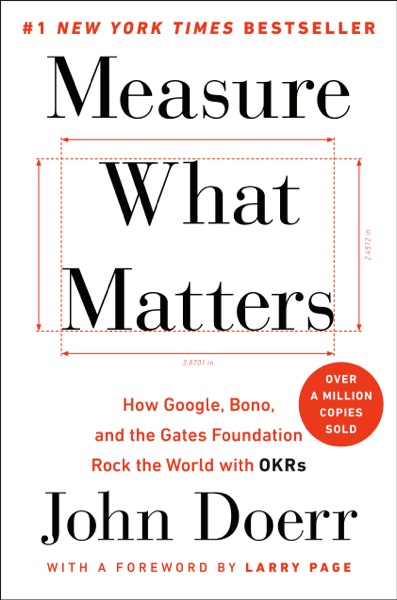
Measure What Matters
by John Doerr
📖 About the book
Measure What Matters: OKRs: The Simple Idea That Drives 10x Growth by John Doerr, published in 2018, is the definitive work on the Objectives and Key Results (OKR) system. Doerr, a legendary venture capitalist who introduced OKRs to Google, argues that execution is everything. This book provides a rigorous framework for Goal Alignment, teaching leaders how to create transparency and accountability across large organizations by focusing on a few critical, high-impact targets.
The core methodology centers on the Four OKR Superpowers: Focus and Commit to Priorities, Align and Connect for Teamwork, Track for Accountability, and Stretch for Amazing. Doerr explains the distinction between Committed OKRs (must achieve) and Aspirational OKRs (10x growth targets). He introduces the concept of CFRs (Conversations, Feedback, and Recognition) as the human engine that powers OKRs. The focus is on moving from 'Annual Cascading Goals' toward Continuous, Agile Strategic Execution.
This is crucial reading for CEOs, startup founders, and operational leads. Readers gain concrete value by accessing Real-World Case Studies from firms like Google and Bono’s ONE Campaign. Practical applications include utilizing 'Public Dashboards' to track progress and implementing Quarterly OKR Cycles to increase organizational agility. By mastering Doerr’s logic, leaders can build organizations that are structurally aligned and capable of achieving explosive, measurable success through the power of focus and transparency.
💡 Key takeaways
Implement the OKR Framework to ensure that every individual in your organization understands the firm’s top strategic priorities and how their tactical efforts contribute to them.
Utilize CFRs (Conversations, Feedback, Recognition) as a continuous performance management system, replacing the outdated annual review with a more agile and supportive leadership model.
Differentiate between Committed and Aspirational Goals, using stretch targets to drive original innovation while ensuring that core organizational operations remain stable and predictable.
❓ FAQ
Is "Measure What Matters" by John Doerr free to download?
Yes. BookHubs provides a free preview for "Measure What Matters". For the full legal text we link to OpenLibrary (Internet Archive), which is also free to read.
What is "Measure What Matters" about?
Free download of the definitive guide to OKRs. Learn how Google, Intel, and the Gates Foundation use Objectives and Key Results to achieve explosive growth.
How long does it take to read "Measure What Matters"?
At an average reading pace of ~250 words per minute, "Measure What Matters" (320 pages) takes roughly 480 minutes — about 8.0 hours. The 3 key takeaways on this page cover the core ideas in under 5 minutes.
What is the ISBN of "Measure What Matters"?
The ISBN of "Measure What Matters" by John Doerr is 978-0525536222, published by Portfolio.
📚 Related books
All books →
The Five Dysfunctions of a Team
Patrick Lencioni

Thinking in Systems
Donella Meadows

The Culture Code
Daniel Coyle

Leadership and the New Science
Margaret Wheatley

Multipliers
Liz Wiseman

No Rules Rules
Reed Hastings, Erin Meyer