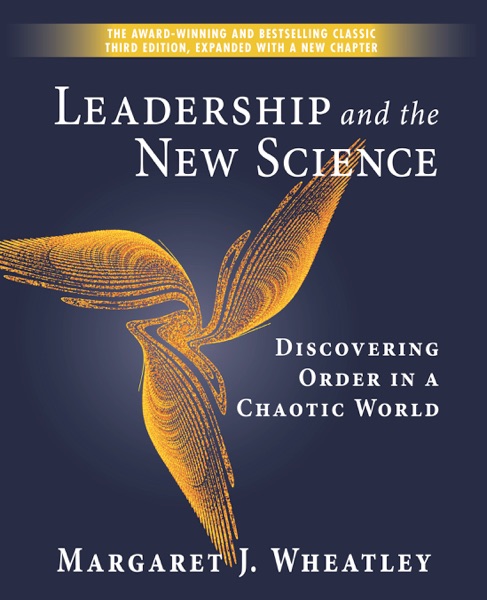
Leadership and the New Science
📖 About the book
Leadership and the New Science: Learning about Organization from an Orderly Universe by Margaret Wheatley, published in 1992, is a profound application of Quantum Physics and Biology to leadership. Wheatley argues that the Newtonian view of organizations as machines is dead. This book provides a framework for Adaptive Leadership, teaching leaders that chaos is a prerequisite for creativity and that order can emerge naturally from 'Information Flow' and 'Relational Fields' rather than from rigid control.
The methodology identifies concepts like Quantum Entanglement, Self-Reference, and Dissipative Structures. Wheatley explains the importance of Information as a Living Force and details why 'Small Disturbances' are necessary for systemic health. She introduces the concept of The Field (shared culture) as the primary organizing force and provides strategies for managing 'Equilibrium vs. Growth.' The focus is on moving from 'Planning as Predictability' toward Leading through Meaning and Presence.
Essential reading for visionary executives and organizational psychologists. Readers gain value by learning how to trust Self-Organizing Processes. Practical applications include utilizing 'Informal Networks' for change management and implementing Diversity-Based Problem Solving. By internalizing Wheatley’s insights, leaders can build organizations that are structurally more graceful and resilient, ensuring they remain relevant by evolving in harmony with the natural laws of a complex universe.
💡 Key takeaways
View Information as your Organization’s Lifeblood, recognizing that open and fluid communication is the primary driver of self-organizing order and strategic adaptation.
Utilize The Field Concept to manage your firm’s culture, recognizing that shared values act as an 'invisible force' that aligns individual actions without the need for constant supervision.
Embrace Chaos as an Innovation Engine, recognizing that periods of systemic instability are necessary for your organization to 're-birth' itself into a higher level of strategic complexity.
❓ FAQ
Is "Leadership and the New Science" by Margaret Wheatley free to download?
Yes. BookHubs provides a free preview for "Leadership and the New Science". For the full legal text we link to OpenLibrary (Internet Archive), which is also free to read.
What is "Leadership and the New Science" about?
Free download of the guide to quantum leadership. Learn how chaos, biology, and physics inform modern organizational management with Margaret Wheatley.
How long does it take to read "Leadership and the New Science"?
At an average reading pace of ~250 words per minute, "Leadership and the New Science" (218 pages) takes roughly 327 minutes — about 5.5 hours. The 3 key takeaways on this page cover the core ideas in under 5 minutes.
What is the ISBN of "Leadership and the New Science"?
The ISBN of "Leadership and the New Science" by Margaret Wheatley is 978-1576753446, published by Berrett-Koehler Publishers.
📚 Related books
All books →
The Five Dysfunctions of a Team
Patrick Lencioni

Thinking in Systems
Donella Meadows

The Culture Code
Daniel Coyle

Multipliers
Liz Wiseman

No Rules Rules
Reed Hastings, Erin Meyer

Measure What Matters
John Doerr