Jab, Jab, Jab, Right Hook
📖 About the book
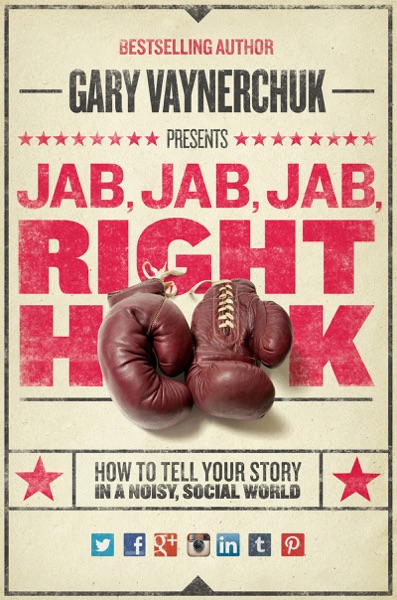
Jab, Jab, Jab, Right Hook: How to Tell Your Story in a Noisy Social World by Gary Vaynerchuk, published in 2013, provides a rigorous framework for Social Media Strategy. Vaynerchuk argues that most brands fail online because they only throw 'right hooks'—constant requests for a sale—without first providing value. This book teaches leaders how to master the 'jab'—the act of creating native, high-value content that builds rapport and trust with an audience over time, fundamentally changing the definition of digital engagement.
The core methodology centers on the distinction between Content and Context. Vaynerchuk explains that each platform (Facebook, Instagram, X/Twitter, etc.) has its own unique 'language' and psychological state of the user. He introduces the Six Characteristics of Great Content, emphasizing that it must be native, non-interruptive, and 'micro.' The framework highlights the importance of Visual Storytelling and providing frameworks for 'Real-Time Marketing' that capitalizes on current trends without being perceived as spam. The focus is on moving from 'Broadcasting' toward Platform-Specific Craft.
This is mandatory reading for social media managers, content creators, and CMOs of consumer brands. Readers gain value by learning how to audit their own digital assets for Native Relevance. Practical applications include utilizing 'Case Study Comparisons' of successful and failed posts to refine creative output and implementing a Give-Give-Give-Ask strategy. By mastering the art of the jab, leaders can build massive, loyal followings that are eager to respond when the organization finally throws the 'right hook' (the call to action).
💡 Key takeaways
Prioritize Value-Driven Jabs by creating 80-90% of your content for the sole purpose of entertaining or educating your audience without asking for anything in return.
Master Contextual Marketing, recognizing that your strategic message must be adapted to the specific culture and technical nuances of each social media platform to be effective.
Utilize Micro-Storytelling to capture the limited attention of modern consumers, focusing on high-quality visuals and short-form copy that resonate with their current interests.
❓ FAQ
Is "Jab, Jab, Jab, Right Hook" by Gary Vaynerchuk free to download?
Yes. BookHubs provides a free preview for "Jab, Jab, Jab, Right Hook". For the full legal text we link to OpenLibrary (Internet Archive), which is also free to read.
What is "Jab, Jab, Jab, Right Hook" about?
Free download of Gary Vaynerchuk's guide to social media. Learn how to tell your story in a noisy world and win with context-driven content marketing.
How long does it take to read "Jab, Jab, Jab, Right Hook"?
At an average reading pace of ~250 words per minute, "Jab, Jab, Jab, Right Hook" (224 pages) takes roughly 336 minutes — about 5.6 hours. The 3 key takeaways on this page cover the core ideas in under 5 minutes.
What is the ISBN of "Jab, Jab, Jab, Right Hook"?
The ISBN of "Jab, Jab, Jab, Right Hook" by Gary Vaynerchuk is 978-0062273062, published by HarperBusiness.
📚 Related books
All books →
Confessions of an Advertising Man
David Ogilvy

The Design of Everyday Things
Don Norman

Ogilvy on Advertising
David Ogilvy

Building a StoryBrand
Donald Miller

Crossing the Chasm
Geoffrey Moore

Pre-Suasion
Robert Cialdini