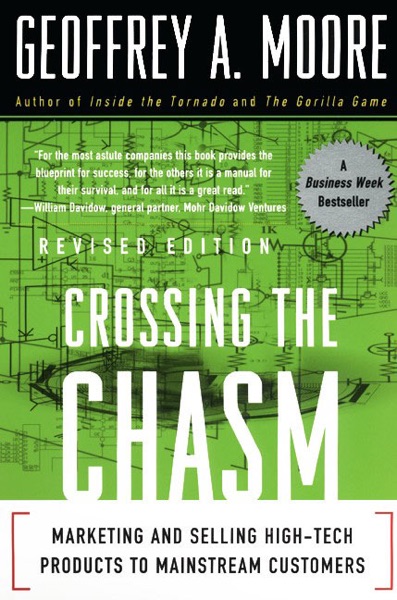
Crossing the Chasm
📖 About the book
Crossing the Chasm by Geoffrey Moore, published in 1991, is a foundational text for High-Tech Marketing. Moore argues that there is a significant gap—a chasm—between the 'Early Adopters' (visionaries) and the 'Early Majority' (pragmatists). This book provides a rigorous framework for navigating this transition, emphasizing that the strategies used to win early enthusiasts will lead to failure when trying to capture a mainstream audience that values stability and proven results over innovation.
The core methodology centers on the Technology Adoption Life Cycle and the 'Beachhead Strategy.' Moore explains that to cross the chasm, a firm must focus on a Niche Market where it can become the dominant leader before expanding. He introduces the concept of the Whole Product—ensuring that the core technology is surrounded by all the services and support needed to provide a total solution. The focus is on moving from 'Revolutionary Claims' toward Pragmatic Reliability to win over skeptical corporate buyers.
This is mandatory reading for tech founders, product managers, and venture capitalists. Readers gain concrete value by learning how to align their Market Positioning with the specific psychological needs of mainstream customers. Practical applications include utilizing 'Target Market Segments' to concentrate resources and redesigning sales channels to favor Consultative Partners. By mastering Moore’s logic, leaders can avoid the 'Death Valley' of tech startups and build scalable, multi-billion dollar enterprises.
💡 Key takeaways
Execute a Beachhead Strategy by focusing your entire organization's resources on a single, specific niche to achieve 100% market dominance before attempting to scale.
Develop the Whole Product by partnering with external vendors to provide all necessary complementary services, ensuring your technology meets the requirements of 'Pragmatist' buyers.
Shift your Value Proposition from 'innovation and features' to 'industry standards and risk reduction' to successfully appeal to the mainstream majority market.
❓ FAQ
Is "Crossing the Chasm" by Geoffrey Moore free to download?
Yes. BookHubs provides a free preview for "Crossing the Chasm". For the full legal text we link to OpenLibrary (Internet Archive), which is also free to read.
What is "Crossing the Chasm" about?
Free download of the definitive guide to tech marketing. Learn how to cross the 'chasm' between early adopters and the mainstream market.
How long does it take to read "Crossing the Chasm"?
At an average reading pace of ~250 words per minute, "Crossing the Chasm" (288 pages) takes roughly 432 minutes — about 7.2 hours. The 3 key takeaways on this page cover the core ideas in under 5 minutes.
What is the ISBN of "Crossing the Chasm"?
The ISBN of "Crossing the Chasm" by Geoffrey Moore is 978-0062353948, published by HarperBusiness.
📚 Related books
All books →
Confessions of an Advertising Man
David Ogilvy

The Design of Everyday Things
Don Norman

Ogilvy on Advertising
David Ogilvy

Building a StoryBrand
Donald Miller

Pre-Suasion
Robert Cialdini

SPIN Selling
Neil Rackham