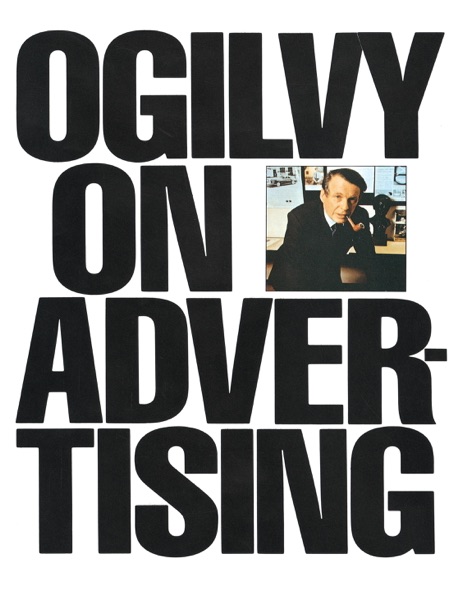
Ogilvy on Advertising
by David Ogilvy
📖 About the book
Ogilvy on Advertising by David Ogilvy, published in 1983, is the definitive manual for Results-Oriented Communication. Ogilvy, the 'Father of Advertising,' argues that advertising is not an art form, but a tool for selling. This book provides a rigorous framework for building brands based on Market Research and the use of 'Long-Copy' that informs and persuades, fundamentally changing how professionals view the intersection of creativity and commerce.
The core methodology centers on the Big Idea and the importance of 'Brand Image.' Ogilvy explains how to write headlines that work and details the role of Direct Response techniques in general advertising. He introduces the concept of the Corporate Identity and provide strategies for managing an agency and winning new business. The focus is on moving from 'Cleverness' toward Strategic Effectiveness, where every word and image is chosen for its ability to drive measurable organizational results.
This is mandatory reading for copywriters, creative directors, and CEOs who want to understand the power of the printed and digital word. Readers gain concrete value by learning how to conduct Consumer Insight studies. Practical applications include utilizing 'Informational Headlines' to increase engagement and redesigning Visual Layouts to favor readability and focus. By internalizing Ogilvy’s principles, leaders can build more persuasive and profitable marketing engines that are grounded in a deep understanding of human psychology and market data.
💡 Key takeaways
Prioritize Market Research as the foundation of your creative strategy, ensuring that your organization's messaging is based on what actually motivates the consumer to buy.
Develop a Big Idea for every campaign—a singular, arresting concept that makes your brand stand out and provides a unified strategic direction for all marketing assets.
Focus on Informational Persuasion, recognizing that 'the more you tell, the more you sell,' especially when dealing with high-stakes or complex product offerings.
❓ FAQ
Is "Ogilvy on Advertising" by David Ogilvy free to download?
Yes. BookHubs provides a free preview for "Ogilvy on Advertising". For the full legal text we link to OpenLibrary (Internet Archive), which is also free to read.
What is "Ogilvy on Advertising" about?
Free download of the advertising 'bible'. Master David Ogilvy's principles of research-based creative and effective sales-driven copy.
How long does it take to read "Ogilvy on Advertising"?
At an average reading pace of ~250 words per minute, "Ogilvy on Advertising" (224 pages) takes roughly 336 minutes — about 5.6 hours. The 3 key takeaways on this page cover the core ideas in under 5 minutes.
What is the ISBN of "Ogilvy on Advertising"?
The ISBN of "Ogilvy on Advertising" by David Ogilvy is 978-0394729039, published by Vintage.
📚 Related books
All books →
Confessions of an Advertising Man
David Ogilvy

The Design of Everyday Things
Don Norman

Building a StoryBrand
Donald Miller

Crossing the Chasm
Geoffrey Moore

Pre-Suasion
Robert Cialdini

SPIN Selling
Neil Rackham