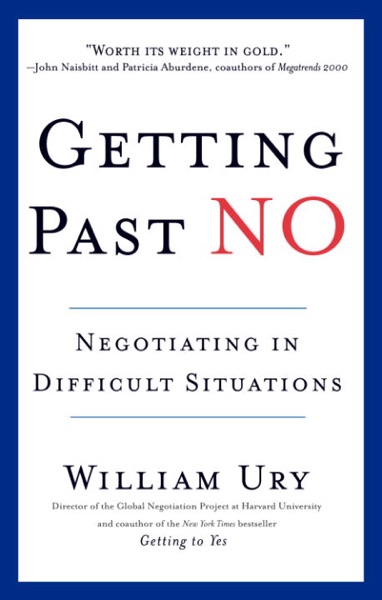
Getting Past No
by William Ury
📖 About the book
Getting Past No: Negotiating in Difficult Situations by William Ury, published in 1991, provides the specialized strategies needed when the other party is uncooperative, aggressive, or deceptive. Ury argues that 'principled negotiation' alone may not work with difficult people who are 'stuck' in a win-lose mindset. This book provides a rigorous, Breakthrough Strategy for turning an adversary into a partner, focusing on how to manage your own reactions and the other person's emotions during high-stakes conflict.
The core framework consists of five stages: Go to the Balcony (maintain emotional distance), Step to Their Side (use tactical empathy), Reframe (change the game), Build a Golden Bridge (make it easy for them to say yes), and Use Power to Educate (not to escalate). Ury explains how to use 'Active Listening' to disarm your opponent and how to use 'Open-Ended Questions' to guide them toward a shared solution. The focus is on moving from 'Confrontation' to Joint Problem-Solving, even when the power balance is unequal.
This is mandatory reading for procurement leads, crisis managers, and executives dealing with hostile takeovers or labor disputes. Readers gain value by learning how to stay calm under fire and how to protect their strategic interests. Practical applications include utilizing the Balcony Technique to avoid reactive mistakes and redesigning negotiation scripts to include 'Face-Saving' options for the opponent. By mastering Ury’s breakthrough method, leaders can overcome the toughest barriers to agreement and secure favorable outcomes in the most challenging organizational environments.
💡 Key takeaways
Practice Going to the Balcony during high-stress interactions, intentionally stepping back to regain emotional control and maintain a focus on your long-term strategic objectives.
Build a Golden Bridge by incorporating the other party's ideas and needs into your proposal, making it psychologically easier and more attractive for them to agree to your terms.
Utilize Tactical Reframing to redirect the conversation from personal attacks or rigid positions toward an objective analysis of the shared strategic problem.
❓ FAQ
Is "Getting Past No" by William Ury free to download?
Yes. BookHubs provides a free preview for "Getting Past No". For the full legal text we link to OpenLibrary (Internet Archive), which is also free to read.
What is "Getting Past No" about?
Free download of William Ury's guide to difficult negotiations. Learn the five-step strategy to turn adversaries into partners and reach agreement.
How long does it take to read "Getting Past No"?
At an average reading pace of ~250 words per minute, "Getting Past No" (189 pages) takes roughly 284 minutes — about 4.7 hours. The 3 key takeaways on this page cover the core ideas in under 5 minutes.
What is the ISBN of "Getting Past No"?
The ISBN of "Getting Past No" by William Ury is 978-0553371314, published by Bantam Books.
📚 Related books
All books →
Atomic Habits
James Clear

Can't Hurt Me
David Goggins

Ego Is the Enemy
Ryan Holiday

Influence
Robert Cialdini

Man's Search for Meaning
Viktor Frankl

Never Split the Difference
Chris Voss