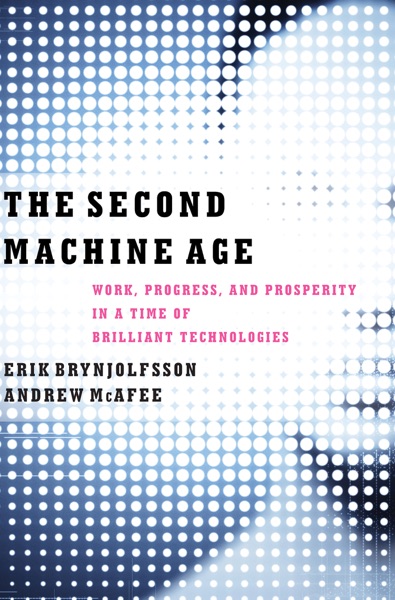
The Second Machine Age
by Erik Brynjolfsson, Andrew McAfee
📖 About the book
The Second Machine Age: Work, Progress, and Prosperity in a Time of Brilliant Technologies by Erik Brynjolfsson and Andrew McAfee, published in 2014, is a rigorous study of Digital Economics. The authors argue that while the first machine age (Industrial Revolution) substituted for physical labor, the second machine age is substituting for Cognitive Labor. This work provides a framework for understanding the 'New Productivity Paradox' and the widening gap between technological abundance and labor income.
The core methodology revolves around the Power of Combinatorial Innovation—using existing digital building blocks to create new value. The authors explain the concept of the Bounty and the Spread (the increase in total wealth vs. the increase in inequality) and detail the importance of 'Human-Machine Collaboration.' They introduce the concept of the Winner-Take-All Market and provide strategies for education and policy reform. The focus is on moving from 'Standard Employment' toward Augmented Professionalism.
Essential reading for economists, HR directors, and business strategists. Readers gain value by learning how to identify the Skills of the Future. Practical applications include utilizing 'Digital Platforms' to scale business models and implementing Automation Audits to see which roles are most susceptible to disruption. By mastering the principles of the Second Machine Age, leaders can build organizations that leverage technology to create exponential value while maintaining social and economic stability.
💡 Key takeaways
Leverage Combinatorial Innovation by integrating diverse digital tools and data sets to create unique strategic value that rivals cannot easily replicate.
Prepare for Winner-Take-All Dynamics in your market, recognizing that digital platforms allow the best performers to capture nearly the entire market share at very low marginal costs.
Focus on Human-Machine Augmentation, redesigning job roles so that your workforce uses technology to enhance their unique human strengths in empathy, creativity, and complex strategy.
❓ FAQ
Is "The Second Machine Age" by Erik Brynjolfsson, Andrew McAfee free to download?
Yes. BookHubs provides a free preview for "The Second Machine Age". For the full legal text we link to OpenLibrary (Internet Archive), which is also free to read.
What is "The Second Machine Age" about?
Free download of the guide to the digital revolution. Learn how AI and automation are transforming the economy and the future of work.
How long does it take to read "The Second Machine Age"?
At an average reading pace of ~250 words per minute, "The Second Machine Age" (320 pages) takes roughly 480 minutes — about 8.0 hours. The 3 key takeaways on this page cover the core ideas in under 5 minutes.
What is the ISBN of "The Second Machine Age"?
The ISBN of "The Second Machine Age" by Erik Brynjolfsson, Andrew McAfee is 978-0393239355, published by W. W. Norton & Company.
📚 Related books
All books →
The Age of Spiritual Machines
Ray Kurzweil

Superintelligence: Paths, Dangers, Strategies
Nick Bostrom

The Singularity Is Nearer
Ray Kurzweil

Abundance
Peter Diamandis, Steven Kotler

Life 3.0
Max Tegmark

Life 3.0: Being Human in the Age of Artificial Intelligence
Max Tegmark