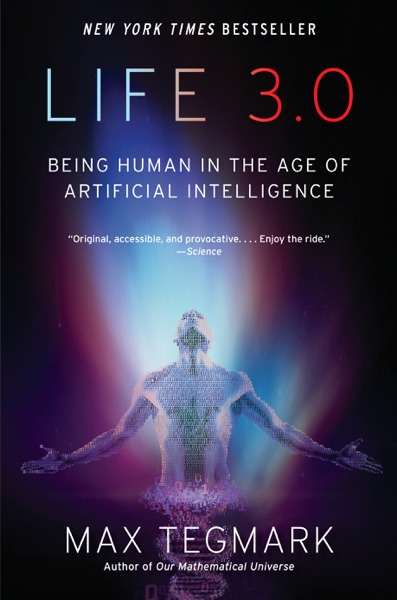
Life 3.0
by Max Tegmark
📖 About the book
Life 3.0: Being Human in the Age of Artificial Intelligence by Max Tegmark, published in 2017, is a rigorous exploration of the Artificial Intelligence Control Problem. Tegmark, an MIT physicist, defines 'Life 3.0' as life that can redesign not just its software (learning), but also its hardware (body). This book provides a framework for understanding the potential paths of AI Takeoff and the existential risks associated with a superintelligent system whose goals are not aligned with human values.
The core methodology identifies Intelligence as Information Processing. Tegmark explains the concept of Goal Alignment—ensuring that powerful AI systems share our objectives—and details the role of 'Recursive Self-Improvement.' He introduces several future scenarios, from 'The Protector God' to 'Human Extinction,' and provide strategies for Safety Research. The focus is on moving from 'Speculative Fear' toward Pragmatic Engineering of beneficial AI that serves the long-term interests of humanity.
This is crucial reading for AI researchers, ethical officers, and C-suite leaders in the tech industry. Readers gain value by learning how to structure AI Governance. Practical applications include utilizing the 'Asilomar AI Principles' for corporate policy and implementing Robustness Checks for autonomous systems. By internalizing Tegmark’s logic, leaders can contribute to a future where AI acts as a force for unprecedented growth and prosperity rather than a source of systemic fragility.
💡 Key takeaways
Prioritize AI Goal Alignment within your organization's technical strategy, recognizing that the most dangerous risk of AI is not malice, but competence with misaligned objectives.
Understand the Recursive Self-Improvement loop, where AI systems begin to design better versions of themselves, leading to a rapid and unpredictable 'Intelligence Explosion'.
Develop Safety-First Innovation Protocols, ensuring that autonomous systems in your firm are designed with verifiable constraints that prevent harmful unintended consequences.
❓ FAQ
Is "Life 3.0" by Max Tegmark free to download?
Yes. BookHubs provides a free preview for "Life 3.0". For the full legal text we link to OpenLibrary (Internet Archive), which is also free to read.
What is "Life 3.0" about?
Free download of the guide to the age of Artificial Intelligence. Explore the future of life and the ethical challenges of Superintelligence with Max Tegmark.
How long does it take to read "Life 3.0"?
At an average reading pace of ~250 words per minute, "Life 3.0" (384 pages) takes roughly 576 minutes — about 9.6 hours. The 3 key takeaways on this page cover the core ideas in under 5 minutes.
What is the ISBN of "Life 3.0"?
The ISBN of "Life 3.0" by Max Tegmark is 978-1101946596, published by Knopf.
📚 Related books
All books →
The Age of Spiritual Machines
Ray Kurzweil

Superintelligence: Paths, Dangers, Strategies
Nick Bostrom

The Singularity Is Nearer
Ray Kurzweil

Abundance
Peter Diamandis, Steven Kotler

Life 3.0: Being Human in the Age of Artificial Intelligence
Max Tegmark

AI Superpowers
Kai-Fu Lee