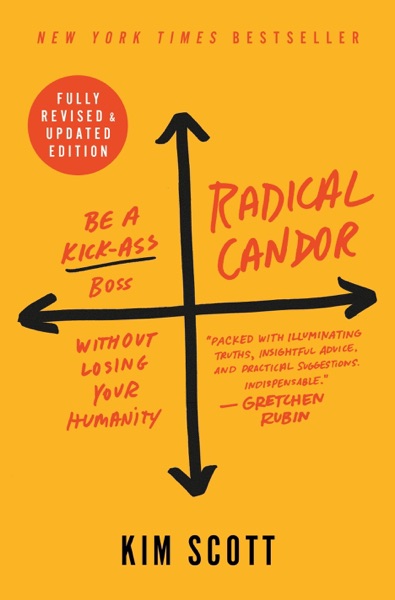
Radical Candor
by Kim Scott
📖 About the book
Radical Candor: Be a Kick-Ass Boss Without Losing Your Humanity by Kim Scott, published in 2017, provides a rigorous framework for Employee Management and Feedback. Scott, a former executive at Google and Apple, argues that the best bosses build cultures where people feel safe but are held to high standards. This work introduces a model for professional communication that avoids the traps of 'Obnoxious Aggression' and 'Ruinous Empathy,' fundamentally changing the nature of Team Accountability.
The core methodology centers on two dimensions: Care Personally and Challenge Directly. When these intersect, you achieve Radical Candor. Scott explains how to give 'Humbling Feedback' and details the importance of Guidance, Team-Building, and Results. She introduces the concept of Rockstars vs. Superstars (steady growth vs. steep trajectory) and providing frameworks for 'Career Conversations.' The focus is on moving from 'Polite Silence' toward Productive Conflict that drives excellence.
Essential reading for managers at all levels, startup founders, and HR leaders. Readers gain concrete value by learning how to build High-Trust Relationships that survive difficult feedback. Practical applications include utilizing the HHH Model (Help, Hang out, Hear) for 1-on-1s and redesigning Performance Reviews to favor growth over evaluation. By mastering radical candor, leaders can build organizations that are more transparent, resilient, and effective at solving strategic problems through honest collaboration.
💡 Key takeaways
Apply Radical Candor by combining deep personal care for your team with the courage to challenge their work directly, ensuring high-performance without fear.
Avoid Ruinous Empathy—the failure to give necessary critical feedback to avoid hurting feelings—as it is the primary driver of organizational mediocrity and employee failure.
Distinguish between Superstars (steep growth) and Rockstars (steady growth) in your talent management, recognizing that a stable organization needs both types of contributors to succeed.