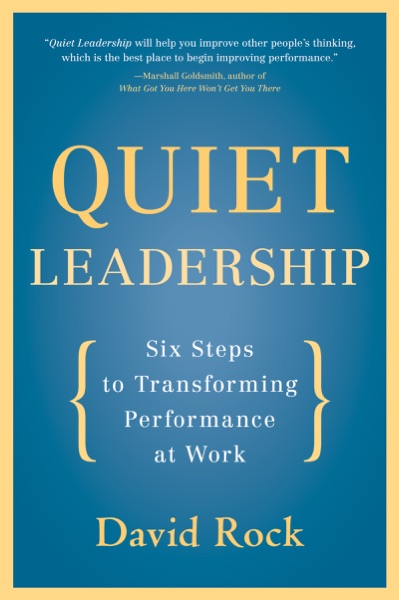
Quiet Leadership
by David Rock
📖 About the book
Quiet Leadership: Six Steps to Transforming Performance at Work by David Rock, published in 2006, is a pioneering work that applies Neuroscience to the art of management. Rock, the founder of the NeuroLeadership Institute, argues that traditional 'advice-giving' management is ineffective because it doesn't account for how the human brain actually processes information and change. This book provides a rigorous, Brain-Based Coaching framework that helps leaders to improve the performance of their teams by helping them think better, rather than telling them what to do.
The core methodology centers on the Six Steps to Quiet Leadership, which include 'Think about Thinking' and 'Listen for Potential.' Rock introduces the Dance of Insight—a specific way of conversing that triggers the 'Aha!' moments in others' brains. He emphasizes the importance of Neuroplasticity and explains how to use focused attention to create new neural pathways and lasting behavioral change. The focus is on moving from 'Problems' to 'Solutions' by asking powerful, open-ended questions that empower the employee to find their own breakthroughs and strategic clarity.
This is essential reading for executive coaches, HR professionals, and senior leaders in high-knowledge industries. Readers gain value by learning how to reduce Organizational Friction and increase employee engagement. Practical applications include utilizing the SCARF Model to manage social threats and designing feedback sessions that minimize defensiveness. By mastering quiet leadership, managers can transform their workplace into a highly innovative and self-correcting environment where collective intelligence is optimized through a deep understanding of the human brain.
💡 Key takeaways
Implement Brain-Based Coaching by shifting your management style from 'giving advice' to asking powerful questions that trigger self-directed insights in your team.
Utilize the Dance of Insight to facilitate high-impact conversations, helping your employees overcome mental blocks and develop their own strategic solutions.
Master Focused Attention techniques to help your workforce create new, high-performance neural pathways, ensuring that organizational change and learning are sustained over time.
❓ FAQ
Is "Quiet Leadership" by David Rock free to download?
Yes. BookHubs provides a free preview for "Quiet Leadership". For the full legal text we link to OpenLibrary (Internet Archive), which is also free to read.
What is "Quiet Leadership" about?
Download the guide to brain-based coaching for free. Learn how to use neuroscience to improve team performance and drive professional growth.
How long does it take to read "Quiet Leadership"?
At an average reading pace of ~250 words per minute, "Quiet Leadership" (304 pages) takes roughly 456 minutes — about 7.6 hours. The 3 key takeaways on this page cover the core ideas in under 5 minutes.
What is the ISBN of "Quiet Leadership"?
The ISBN of "Quiet Leadership" by David Rock is 978-0060835903, published by HarperBusiness.
📚 Related books
All books →
The 21 Irrefutable Laws of Leadership
John Maxwell

Dare to Lead
Brené Brown

How to Win Friends and Influence People
Dale Carnegie

Shoe Dog
Phil Knight

The Laws of Human Nature
Robert Greene

Think Again
Adam Grant