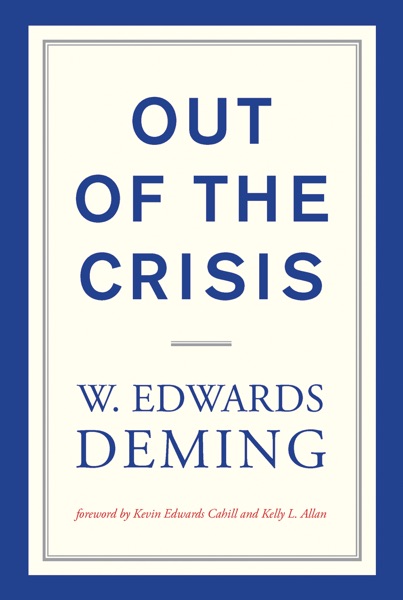
Quality Management
📖 About the book
Quality Management (reflecting the life's work of W. Edwards Deming) is the philosophical and mathematical foundation for the modern quality movement. Deming, who transformed post-war Japanese industry, argues that quality is not something to be 'inspected' at the end of a line, but something built into the process through Statistical Thinking. This work provides the definitive framework for Total Quality Management (TQM), challenging the traditional management models that prioritize short-term quotas over long-term systemic excellence.
The core of Deming's methodology is the PDSA Cycle (Plan-Do-Study-Act), a scientific approach to continuous improvement. He introduces the concept of Statistical Process Control (SPC), teaching managers to distinguish between 'Common Cause' variation (inherent in the system) and 'Special Cause' variation (external disruptions). Deming emphasizes that 94% of problems are caused by the system, not the worker, and advocates for the removal of fear and the elimination of annual merit ratings that destroy Intrinsic Motivation and team collaboration.
This is mandatory reading for manufacturing executives, operations managers, and process engineers. Readers gain unparalleled depth in understanding how to reduce costs by increasing quality. Practical applications include utilizing Control Charts to monitor output and restructuring departments to optimize the 'Total System.' By studying Deming's original vision, leaders can build an Organization-Wide Culture of Quality that ensures consistent performance, lower waste, and higher customer satisfaction in any competitive environment.
💡 Key takeaways
Implement the PDSA Cycle (Plan-Do-Study-Act) as a rigorous, scientific framework for testing and validating all process improvements across your organization.
Utilize Statistical Process Control (SPC) to objectively monitor your workflows, focusing management effort on fixing systemic issues rather than blaming individual workers for variation.
Foster a culture of Continuous Quality Improvement by removing fear from the workplace and eliminating numerical quotas that encourage cutting corners at the expense of excellence.