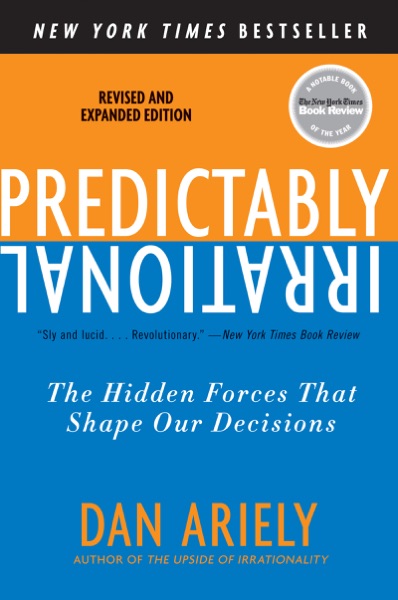
Predictably Irrational
by Dan Ariely
📖 About the book
Predictably Irrational: The Hidden Forces That Shape Our Decisions by Dan Ariely, published in 2008, challenges the traditional economic assumption that humans act rationally. Ariely, a professor of behavioral economics, argues that our 'irrationality' is not random but follows predictable patterns. This book provides a rigorous, Experimental Framework for understanding consumer behavior and employee motivation, offering leaders the tools to design better products, policies, and strategies by accounting for the quirks of the human mind.
The core methodology centers on the Decoy Effect, the influence of 'Free!', and the power of social vs. market norms. Ariely explains why we are often 'Relativists' in our choices and how Anchoring affects our perception of value. He details the concept of Self-Control and the 'Cost of Zero,' showing how seemingly small changes in environment can lead to massive shifts in decision-making. The focus is on moving beyond 'Economic Man' toward a more realistic model of Human-Centric Design that leverages these predictable biases for organizational growth.
Essential for marketers, product managers, and HR directors. Readers gain concrete value by learning how to price their products more effectively and how to build High-Engagement Workplaces. Practical applications include utilizing 'Social Norms' to drive team performance and redesigning customer journeys to eliminate the 'pain of paying.' By mastering Ariely’s principles, leaders can ensure their strategic offerings are aligned with how people actually think and behave, driving higher conversion and customer loyalty.
💡 Key takeaways
Utilize the Decoy Effect in your product pricing strategy to guide customers toward your target offerings by providing a less attractive comparative option.
Understand the distinction between Social and Market Norms, recognizing that offering money for certain tasks (like employee collaboration) can actually decrease motivation.
Apply the Principle of Relativism by carefully selecting the 'Anchor' for your strategic proposals, as the first price or idea presented will set the standard for all subsequent evaluations.
❓ FAQ
Is "Predictably Irrational" by Dan Ariely free to download?
Yes. BookHubs provides a free preview for "Predictably Irrational". For the full legal text we link to OpenLibrary (Internet Archive), which is also free to read.
What is "Predictably Irrational" about?
Free download of Dan Ariely's guide to human behavior. Learn how to leverage the hidden forces that shape our decisions in marketing and management.
How long does it take to read "Predictably Irrational"?
At an average reading pace of ~250 words per minute, "Predictably Irrational" (304 pages) takes roughly 456 minutes — about 7.6 hours. The 3 key takeaways on this page cover the core ideas in under 5 minutes.
What is the ISBN of "Predictably Irrational"?
The ISBN of "Predictably Irrational" by Dan Ariely is 978-0061353239, published by HarperCollins.
📚 Related books
All books →
Atomic Habits
James Clear

Can't Hurt Me
David Goggins

Ego Is the Enemy
Ryan Holiday

Influence
Robert Cialdini

Man's Search for Meaning
Viktor Frankl

Never Split the Difference
Chris Voss