Positioning
📖 About the book
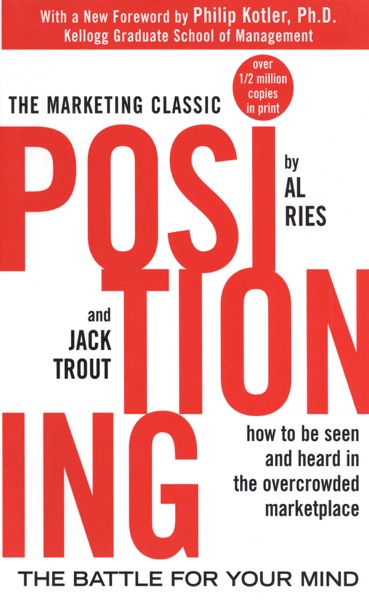
Positioning: The Battle for Your Mind by Al Ries and Jack Trout, first published in 1981, is the definitive guide to Brand Strategy. The authors argue that in an 'over-communicated' society, the goal of marketing is not to create something new but to manipulate what is already in the mind. This book provides a rigorous framework for Mental Real Estate, teaching leaders how to find a 'hole' in the prospect's mind and occupy it with a simple, powerful concept that rivals cannot easily dislodge.
The core methodology centers on the Law of Leadership and the importance of being 'First.' Ries and Trout explain that if you cannot be first in a category, you must create a New Category where you can be first. They detail the risks of 'Line Extension' and the necessity of 'Narrowing the Focus' to achieve brand clarity. The framework emphasizes that positioning is not what you do to a product, but what you do to the mind of the prospect, focusing on Simplified Communication in a world of information overload.
Essential for brand managers, advertising executives, and startup founders. Readers gain value by learning how to identify their 'Competitor’s Weakness' and how to build a Defensible Brand Identity. Practical applications include utilizing 'The Against Position' to challenge market leaders and redesigning corporate naming strategies to favor Memorable Positioning. By mastering these principles, leaders can ensure their organization's message cuts through the noise and secures a permanent, profitable place in the consumer's consciousness.
💡 Key takeaways
Identify a Unique Mental Category for your brand, recognizing that being first in the mind is more strategically important than having the technically superior product.
Avoid the Line Extension Trap, ensuring that your brand name remains associated with a single, clear positioning rather than being diluted across multiple unrelated products.
Utilize Competitive Re-positioning to define your rivals in a way that highlights your own organization's unique advantages, effectively narrowing the choice for the consumer.
❓ FAQ
Is "Positioning" by Al Ries, Jack Trout free to download?
Yes. BookHubs provides a free preview for "Positioning". For the full legal text we link to OpenLibrary (Internet Archive), which is also free to read.
What is "Positioning" about?
Free download of the marketing classic on positioning. Learn how to capture a unique space in the mind of the prospect and win the battle for attention.
How long does it take to read "Positioning"?
At an average reading pace of ~250 words per minute, "Positioning" (224 pages) takes roughly 336 minutes — about 5.6 hours. The 3 key takeaways on this page cover the core ideas in under 5 minutes.
What is the ISBN of "Positioning"?
The ISBN of "Positioning" by Al Ries, Jack Trout is 978-0071373586, published by McGraw-Hill.
📚 Related books
All books →
Confessions of an Advertising Man
David Ogilvy

The Design of Everyday Things
Don Norman

Ogilvy on Advertising
David Ogilvy

Building a StoryBrand
Donald Miller

Crossing the Chasm
Geoffrey Moore

Pre-Suasion
Robert Cialdini