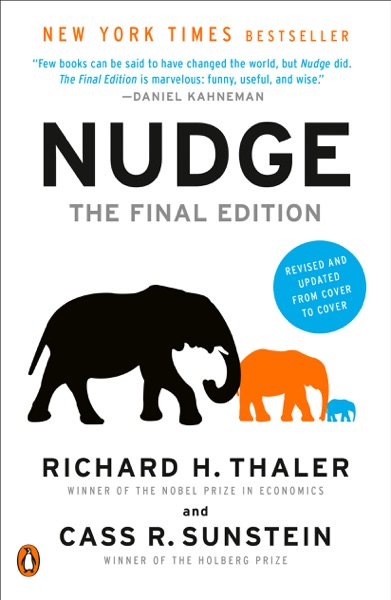
Nudge
by Richard Thaler, Cass Sunstein
📖 About the book
Nudge: Improving Decisions About Health, Wealth, and Happiness by Richard Thaler and Cass Sunstein, published in 2008, introduced the concept of Choice Architecture to a global audience. The authors argue that because people are prone to biases and errors, organizations should design environments that 'nudge' individuals toward better outcomes without restricting their freedom of choice. This book provides a rigorous, Policy-Based Framework for leaders to improve organizational efficiency and customer satisfaction through subtle systemic changes.
The core methodology revolves around the Default Option and the use of 'Incentives' and 'Feedback.' Thaler and Sunstein explain the principles of Libertarian Paternalism, arguing that designers have a responsibility to guide choices toward the individual's long-term best interest. They detail the NUDGES Acronym (iNcentives, Understand mapping, Defaults, Give feedback, Expect error, Structure complex choices) as a toolkit for system designers. The focus is on moving from 'Mandates' to Behavioral Design, where strategic goals are achieved through the path of least resistance.
This is crucial reading for policy makers, HR professionals, and experience designers. Readers gain value by learning how to increase 401(k) participation, improve workplace safety, and drive sustainable consumer choices. Practical applications include utilizing Smart Defaults in software and redesigning Office Layouts to foster collaboration. By mastering the art of the nudge, leaders can achieve significant strategic impact with minimal cost, creating organizations that are both highly effective and respectful of individual autonomy.
💡 Key takeaways
Implement Choice Architecture by designing 'Smart Defaults' that automatically enroll stakeholders in the most beneficial options, such as retirement plans or health initiatives.
Utilize the NUDGES Framework to systematically audit your organization’s internal processes, ensuring that information and incentives are structured to promote high-performance choices.
Apply Behavioral Design to reduce the cost of organizational change, focusing on subtle environmental adjustments that make the desired new behavior the easiest path for employees.
❓ FAQ
Is "Nudge" by Richard Thaler, Cass Sunstein free to download?
Yes. BookHubs provides a free preview for "Nudge". For the full legal text we link to OpenLibrary (Internet Archive), which is also free to read.
What is "Nudge" about?
Free download of the guide to choice architecture. Learn how to use 'nudges' to improve health, wealth, and organizational performance with Richard Thaler.
How long does it take to read "Nudge"?
At an average reading pace of ~250 words per minute, "Nudge" (304 pages) takes roughly 456 minutes — about 7.6 hours. The 3 key takeaways on this page cover the core ideas in under 5 minutes.
What is the ISBN of "Nudge"?
The ISBN of "Nudge" by Richard Thaler, Cass Sunstein is 978-0143115267, published by Yale University Press.
📚 Related books
All books →
Atomic Habits
James Clear

Can't Hurt Me
David Goggins

Ego Is the Enemy
Ryan Holiday

Influence
Robert Cialdini

Man's Search for Meaning
Viktor Frankl

Never Split the Difference
Chris Voss