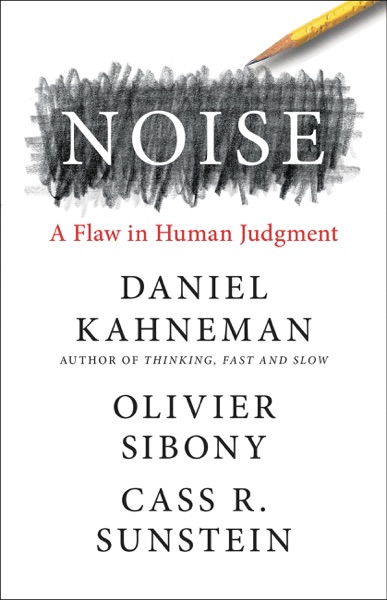
Noise
📖 About the book
Noise: A Flaw in Human Judgment by Daniel Kahneman, Olivier Sibony, and Cass Sunstein, published in 2021, is a rigorous study of Systemic Variability. The authors argue that while 'Bias' is well-known, 'Noise'—unwanted inconsistency in judgments—is a silent killer of organizational efficiency. This book provides a framework for Decision Hygiene, teaching leaders how to measure and reduce the random error that leads to unfairness and massive financial loss in everything from hiring to strategic forecasting.
The methodology identifies different types of noise, such as Occasion Noise and Level Noise. The authors explain the concept of the Judgment Audit and detail why 'Algorithms' are often more reliable than human experts precisely because they are noise-free. He introduces the concept of Decision Guiding and provides strategies for 'Structuring Judgments.' The focus is on moving from 'Intuitive Guessing' toward Principled, Reliable Evaluation.
This is mandatory reading for HR directors, legal professionals, and risk managers. Readers gain concrete value by learning how to conduct a Noise Audit within their firms. Practical applications include utilizing 'Independent Assessments' for project reviews and implementing Rules-Based Aggregation for team decisions. By internalizing Kahneman’s insights, leaders can significantly increase the consistency and quality of their organization's strategic output.
💡 Key takeaways
Differentiate between Bias and Noise, recognizing that reducing the random variability in your team's judgments is as important as eliminating systematic prejudice.
Implement Decision Hygiene protocols, such as using structured rubrics and delaying intuition, to ensure that organizational choices remain consistent across different individuals and times.
Utilize Algorithms and Decision Rules for repetitive high-stakes tasks, recognizing that even simple models consistently out-perform human experts by eliminating 'Occasion Noise'.
❓ FAQ
Is "Noise" by Daniel Kahneman et al. free to download?
Yes. BookHubs provides a free preview for "Noise". For the full legal text we link to OpenLibrary (Internet Archive), which is also free to read.
What is "Noise" about?
Free download of the guide to human judgment. Learn how to identify and reduce 'Noise'—unwanted variability in decision-making—with Daniel Kahneman.
How long does it take to read "Noise"?
At an average reading pace of ~250 words per minute, "Noise" (464 pages) takes roughly 696 minutes — about 11.6 hours. The 3 key takeaways on this page cover the core ideas in under 5 minutes.
What is the ISBN of "Noise"?
The ISBN of "Noise" by Daniel Kahneman et al. is 978-0316451406, published by Little, Brown and Company.
📚 Related books
All books →
The Age of Spiritual Machines
Ray Kurzweil

Superintelligence: Paths, Dangers, Strategies
Nick Bostrom

The Singularity Is Nearer
Ray Kurzweil

Abundance
Peter Diamandis, Steven Kotler

Life 3.0
Max Tegmark

Life 3.0: Being Human in the Age of Artificial Intelligence
Max Tegmark