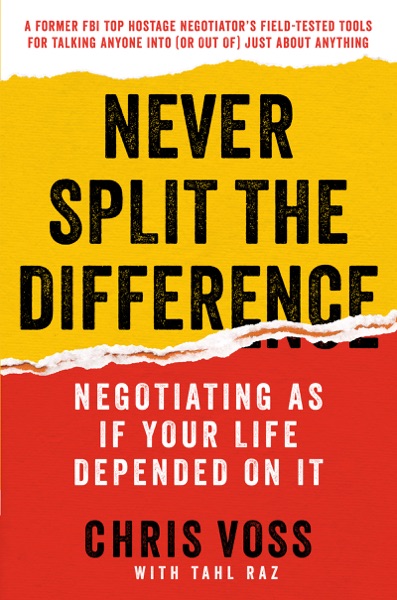
Never Split the Difference
by Chris Voss
📖 About the book
Never Split the Difference: Negotiating As If Your Life Depended On It by Chris Voss, published in 2016, is a revolutionary approach to High-Stakes Negotiation. Voss, a former lead FBI hostage negotiator, argues that traditional negotiation theory (based on rational compromise) fails because it ignores human emotion. This book provides a rigorous framework for Tactical Empathy, teaching leaders how to use emotional intelligence to disarm opponents and achieve superior outcomes in any business or personal conflict.
The core methodology centers on techniques like Mirroring, Labeling, and Calibrated Questions. Voss explains the concept of 'Black Swans'—the hidden pieces of information that change everything—and details why 'No' is often better than 'Yes' as a starting point. He introduces the Ackerman Model for bargaining and provides strategies for managing 'The Accusation Audit.' The focus is on moving from 'Rational Bartering' toward Psychological Influence that secures 100% of the value without destroying the relationship.
Essential reading for CEOs, sales directors, and procurement leads. Readers gain value by learning how to handle Aggressive Negotiators and high-pressure deadlines. Practical applications include utilizing 'The F-word' (Fairness) strategically and implementing Tonal Modulation to project authority and calm. By mastering Voss’s FBI-tested logic, leaders can build organizations that are more persuasive and structurally efficient at securing high-value strategic partnerships.
💡 Key takeaways
Practice Tactical Empathy by listening intensely to your counterpart's underlying emotions, which allows you to identify their true strategic motivations and fears.
Utilize Calibrated Questions (starting with 'How' or 'What') to force your opponent to think about your problems, effectively turning them into a collaborator in finding a solution.
Avoid Splitting the Difference, recognizing that compromise often leads to a suboptimal 'lose-lose' result; instead, aim for a creative solution that addresses the root of the conflict.