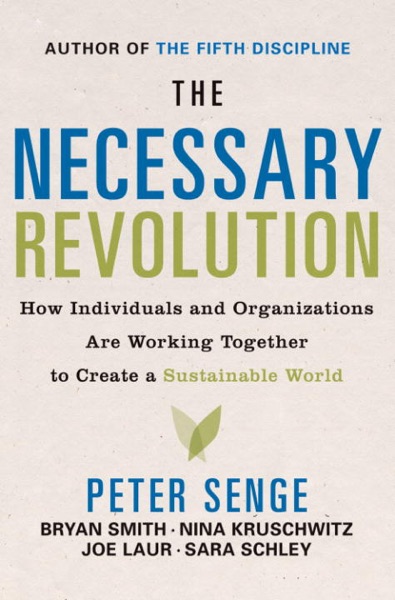
The Necessary Revolution
📖 About the book
The Necessary Revolution: How Individuals and Organizations Are Working Together to Create a Sustainable World by Peter Senge, Bryan Smith, and others, is a rigorous manual for Corporate Sustainability Strategy. The authors argue that the transition to a sustainable future is the biggest strategic opportunity of our time. This work provides a framework for Sustainability-Led Innovation, teaching leaders how to move beyond 'Compliance' to build organizations that thrive by solving the world's most pressing environmental and social problems.
The core methodology revolves around The Industrial Age Bubble and the 'Systems-Level Value' creation. Senge explains the importance of Cross-Sector Collaboration and details the role of 'Shared Vision' in driving large-scale change. He introduces the concept of the Circular Business Model and provides strategies for 'Overcoming Organizational Resistance to Sustainability.' The focus is on moving from 'Value-Extraction' toward Generative Organizational Systems.
This is mandatory reading for CEOs, innovation directors, and supply chain leads. Readers gain value by learning how to build High-Performance Sustainability Teams. Practical applications include utilizing 'Systems Mapping' for waste reduction and implementing Full-Cost Accounting for strategic projects. By Mastering the necessary revolution, leaders can ensure their firm’s long-term profitability is supported by—and contributes to—the health of the global social and natural systems.
💡 Key takeaways
View Sustainability as a Strategic Innovation Engine, recognizing that the most successful firms of the future will be those that solve ecological and social constraints through their core products.
Foster Cross-Sector Partnerships, ensuring that your organization collaborates with governments and NGOs to address the systemic challenges that no single firm can solve alone.
Implement Systems-Level Thinking in your firm’s value chain, recognizing that the long-term cost of environmental degradation will eventually manifest as a primary strategic risk for the business.
❓ FAQ
Is "The Necessary Revolution" by Peter Senge et al. free to download?
Yes. BookHubs provides a free preview for "The Necessary Revolution". For the full legal text we link to OpenLibrary (Internet Archive), which is also free to read.
What is "The Necessary Revolution" about?
Free download of the guide to corporate sustainability. Learn how leading companies are creating value through environmental and social responsibility.
How long does it take to read "The Necessary Revolution"?
At an average reading pace of ~250 words per minute, "The Necessary Revolution" (416 pages) takes roughly 624 minutes — about 10.4 hours. The 3 key takeaways on this page cover the core ideas in under 5 minutes.
What is the ISBN of "The Necessary Revolution"?
The ISBN of "The Necessary Revolution" by Peter Senge et al. is 978-0385519013, published by Doubleday.
📚 Related books
All books →
7 Habits of Highly Effective People
Stephen Covey

High Output Management
Andrew Grove

The Righteous Mind
Jonathan Haidt

Antifragile
Nassim Taleb

Business Model Generation
Osterwalder, Pigneur

Management
Peter Drucker