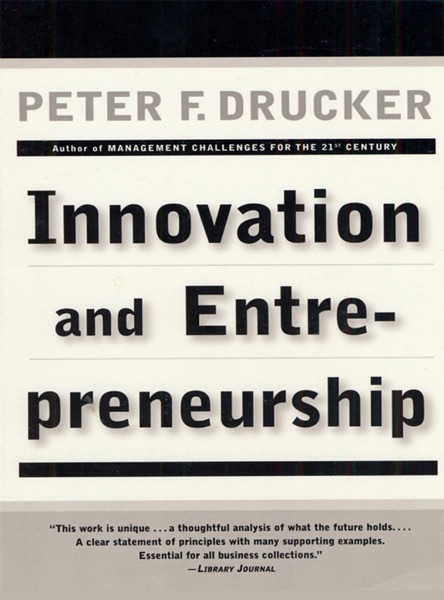
Innovation and Entrepreneurship
📖 About the book
Innovation and Entrepreneurship by Peter Drucker, published in 1985, was the first book to treat innovation and entrepreneurship as a purposeful and systematic discipline. Drucker argues that innovation is not a flash of genius but a deliberate process that can be managed and measured. This seminal work provided the intellectual framework for the "entrepreneurial economy" and remains a primary guide for any organization seeking to foster a culture of creativity and growth in an increasingly competitive world.
The book outlines the Seven Sources of Innovative Opportunity, ranging from the "unexpected success or failure" to changes in "industry and market structures" and "demographics." Drucker emphasizes that entrepreneurship is a behavior rather than a personality trait, and it must be practiced at every level of an organization. He introduces Entrepreneurial Management, which requires established companies to abandon the old and obsolete to make room for the new. He also details specific Entrepreneurial Strategies, such as "Fustest with the Mostest" and "Creative Imitation," for successfully bringing innovations to market.
Essential for R&D managers, startup founders, and corporate innovators. Readers gain value by learning how to systematically scan the environment for opportunities rather than waiting for inspiration. Real-world applications include implementing a Systematic Abandonment policy to free up resources for new ventures and utilizing Drucker's "Entrepreneurial Judo" to take market share from established giants. By following these principles, leaders can transform their organizations into engines of continuous innovation that thrive on change rather than fearing it.
💡 Key takeaways
Systematically scan for growth by analyzing the Seven Sources of Innovative Opportunity, such as unexpected successes, industry shifts, and demographic changes in your market.
Implement a policy of Systematic Abandonment, regularly identifying and terminating obsolete products or processes to redirect resources toward new, innovative ventures.
Apply Entrepreneurial Management practices within established firms to foster a risk-taking culture that can successfully compete with nimble startups and industry disruptors.
❓ FAQ
Is "Innovation and Entrepreneurship" by Peter Drucker free to download?
Yes. BookHubs provides a free preview for "Innovation and Entrepreneurship". For the full legal text we link to OpenLibrary (Internet Archive), which is also free to read.
What is "Innovation and Entrepreneurship" about?
Download Peter Drucker's guide to systematic innovation for free. Learn how to identify and exploit opportunities for growth and market leadership.
How long does it take to read "Innovation and Entrepreneurship"?
At an average reading pace of ~250 words per minute, "Innovation and Entrepreneurship" (288 pages) takes roughly 432 minutes — about 7.2 hours. The 3 key takeaways on this page cover the core ideas in under 5 minutes.
What is the ISBN of "Innovation and Entrepreneurship"?
The ISBN of "Innovation and Entrepreneurship" by Peter Drucker is 978-0060546748, published by Harper & Row.
📚 Related books
All books →
7 Habits of Highly Effective People
Stephen Covey

High Output Management
Andrew Grove

The Righteous Mind
Jonathan Haidt

Antifragile
Nassim Taleb

Business Model Generation
Osterwalder, Pigneur

Management
Peter Drucker