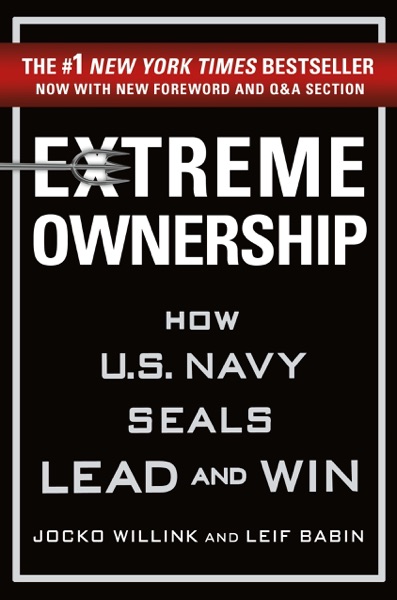
Extreme Ownership
📖 About the book
Extreme Ownership by Jocko Willink and Leif Babin, published in 2015, is a high-impact leadership guide derived from the battlefield experiences of U.S. Navy SEALs. The authors argue that there are no bad teams, only bad leaders, and that the fundamental principle of success is Extreme Ownership—the leader's absolute accountability for everything that happens under their watch. This book has transformed corporate cultures worldwide by stripping away excuses and providing a direct, non-nonsense roadmap for leading through adversity and achieving victory.
The book details the Laws of Combat: Cover and Move, Simple, Prioritize and Execute, and Decentralized Command. Willink and Babin explain how these tactical principles translate to the boardroom, emphasizing the need for Strategic Clarity and the removal of personal ego. They introduce the concept of 'Leading Up and Down the Chain of Command,' teaching managers how to support their superiors and empower their subordinates simultaneously. The framework stresses that leadership is a constant 'dichotomy'—a balance between being aggressive but not overbearing, and disciplined but not rigid.
Essential reading for CEOs, team leads, and project managers in high-pressure industries. Readers gain value by learning how to eliminate the blame culture that destroys organizational performance. Practical applications include utilizing Standard Operating Procedures for crisis response and redesigning planning processes to favor simplicity and actionable goals. By internalizing the mindset of Extreme Ownership, leaders can build highly disciplined, lethal teams that are capable of executing complex strategies and delivering superior results regardless of external circumstances.
💡 Key takeaways
Practice Extreme Ownership by taking absolute responsibility for every failure within your team, ensuring that you focus on solving problems rather than finding scapegoats.
Implement Decentralized Command by providing your junior leaders with the strategic intent and authority needed to make critical decisions without waiting for top-down approval.
Apply the Prioritize and Execute principle by identifying the highest-impact challenge in any crisis and focusing all team resources on it before moving to the next task.
❓ FAQ
Is "Extreme Ownership" by Jocko Willink free to download?
Yes. BookHubs provides a free preview for "Extreme Ownership". For the full legal text we link to OpenLibrary (Internet Archive), which is also free to read.
What is "Extreme Ownership" about?
Free download of Extreme Ownership. Learn how Navy SEAL leadership principles can be applied to lead and win in any business environment.
How long does it take to read "Extreme Ownership"?
At an average reading pace of ~250 words per minute, "Extreme Ownership" (320 pages) takes roughly 480 minutes — about 8.0 hours. The 3 key takeaways on this page cover the core ideas in under 5 minutes.
What is the ISBN of "Extreme Ownership"?
The ISBN of "Extreme Ownership" by Jocko Willink is 978-1250067050, published by St. Martin's Press.
📚 Related books
All books →
The 21 Irrefutable Laws of Leadership
John Maxwell

Dare to Lead
Brené Brown

How to Win Friends and Influence People
Dale Carnegie

Shoe Dog
Phil Knight

The Laws of Human Nature
Robert Greene

Think Again
Adam Grant