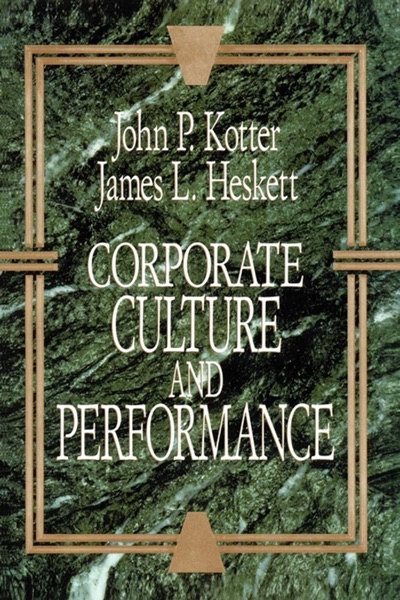
Corporate Culture and Performance
📖 About the book
Corporate Culture and Performance by John Kotter and James Heskett, published in 1992, provides the first large-scale empirical evidence that culture is a primary driver of financial results. Based on a study of over 200 companies, the authors demonstrate that firms with cultures that emphasize all key constituencies (customers, stockholders, and employees) significantly outperform those that do not. This book moved Corporate Culture from a 'soft' HR topic to a 'hard' strategic variable that executives must manage to ensure long-term profitability.
The book distinguishes between Adaptive Cultures and Unadaptive Cultures. Adaptive cultures are characterized by leaders who look outward for change and are willing to take risks to improve performance, while unadaptive cultures become insular, bureaucratic, and resistant to new ideas. Kotter and Heskett explain how 'strong' cultures can actually become a liability if they are not aligned with the competitive environment. They provide a roadmap for Culture Change, emphasizing that it must be led by senior management and anchored in measurable improvements in business performance.
Essential for senior executives, organizational development specialists, and investors. Readers gain value by learning how to diagnose whether their organization's culture is an asset or a hidden threat to its strategy. Real-world applications include identifying the Cultural Barriers to innovation and restructuring incentive systems to reward adaptive behavior. By mastering the link between culture and performance, leaders can build an organization that is not only successful today but also capable of evolving to meet the challenges of tomorrow.
💡 Key takeaways
Foster an Adaptive Corporate Culture where employees and leaders are encouraged to proactively seek out market changes and take calculated risks to improve performance.
Recognize that a Strong Culture can become a strategic weakness if it encourages insularity and resistance to change, making alignment with the environment more important than strength alone.
Lead Cultural Transformation from the top down by explicitly linking new values and behaviors to tangible improvements in the company's financial and operational results.
❓ FAQ
Is "Corporate Culture and Performance" by Kotter, Heskett free to download?
Yes. BookHubs provides a free preview for "Corporate Culture and Performance". For the full legal text we link to OpenLibrary (Internet Archive), which is also free to read.
What is "Corporate Culture and Performance" about?
Download the landmark study on culture for free. Learn how an adaptive corporate culture directly impacts long-term financial success.
How long does it take to read "Corporate Culture and Performance"?
At an average reading pace of ~250 words per minute, "Corporate Culture and Performance" (214 pages) takes roughly 321 minutes — about 5.3 hours. The 3 key takeaways on this page cover the core ideas in under 5 minutes.
What is the ISBN of "Corporate Culture and Performance"?
The ISBN of "Corporate Culture and Performance" by Kotter, Heskett is 978-0029184677, published by Free Press.
📚 Related books
All books →
7 Habits of Highly Effective People
Stephen Covey

High Output Management
Andrew Grove

The Righteous Mind
Jonathan Haidt

Antifragile
Nassim Taleb

Business Model Generation
Osterwalder, Pigneur

Management
Peter Drucker