Co-opetition
📖 About the book
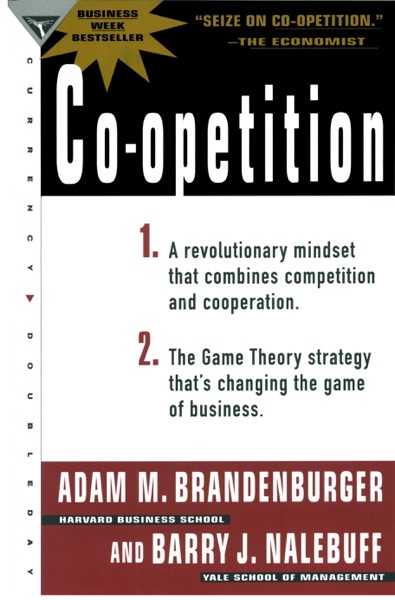
Co-opetition by Adam Brandenburger and Barry Nalebuff, published in 1996, is a revolutionary work that challenged the traditional 'war' metaphor of business. The authors argue that most firms focus too much on taking a bigger slice of the pie rather than making the pie larger. This book introduces a new mindset—Co-opetition—which involves competing and cooperating simultaneously. It provides a rigorous, game-theory-based framework for understanding how to work with rivals to expand markets while maintaining a competitive edge to capture the resulting value.
The central framework is the PARTS model, which outlines the five levers managers can use to change the game of business: Players, Added Value, Rules, Tactics, and Scope. The authors explain how to identify Complementors (players whose products make yours more valuable) and how to manage the delicate balance of 'cooperative competition.' They emphasize that strategy is about choosing the right game as much as it is about playing it well. The book provides numerous case studies, from Intel and Microsoft to the airline industry, illustrating how changing one element of PARTS can radically shift market dynamics.
Essential for CEOs, business development officers, and strategic planners. Readers gain concrete value by learning how to find win-win opportunities with traditional competitors. Practical applications include utilizing Value Net Analysis to find underserved market segments and redesigning supply chain contracts to align the incentives of all players. By mastering co-opetition, organizations can reduce the costs of destructive price wars and focus their energy on collaborative innovation that creates sustainable, industry-wide growth and higher individual profit margins.
💡 Key takeaways
Apply the PARTS Framework (Players, Added Value, Rules, Tactics, Scope) to systematically identify opportunities to change the competitive dynamics of your industry in your favor.
Identify your Complementors—companies whose products increase the demand for yours—and develop cooperative strategies to grow the overall market together.
Shift from a Win-Lose Mindset to a co-opetitive approach, finding ways to cooperate with rivals on infrastructure or standards while continuing to compete on final products.
❓ FAQ
Is "Co-opetition" by Brandenburger, Nalebuff free to download?
Yes. BookHubs provides a free preview for "Co-opetition". For the full legal text we link to OpenLibrary (Internet Archive), which is also free to read.
What is "Co-opetition" about?
Download the classic on strategic partnership for free. Learn how to combine competition and cooperation to grow your market and increase profits.
How long does it take to read "Co-opetition"?
At an average reading pace of ~250 words per minute, "Co-opetition" (304 pages) takes roughly 456 minutes — about 7.6 hours. The 3 key takeaways on this page cover the core ideas in under 5 minutes.
What is the ISBN of "Co-opetition"?
The ISBN of "Co-opetition" by Brandenburger, Nalebuff is 978-0385416771, published by Currency.
📚 Related books
All books →
7 Habits of Highly Effective People
Stephen Covey

High Output Management
Andrew Grove

The Righteous Mind
Jonathan Haidt

Antifragile
Nassim Taleb

Business Model Generation
Osterwalder, Pigneur

Management
Peter Drucker