Verbal Judo
📖 About the book
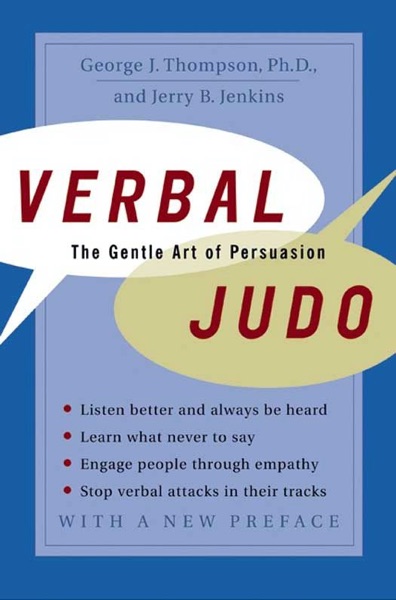
Verbal Judo: The Gentle Art of Persuasion by George Thompson, published in 1993, provides a unique framework for managing high-conflict interpersonal interactions. Thompson, a former police officer and English professor, argues that communication is a Martial Art where the goal is to redirect the 'attacker's' energy toward a productive resolution. This work provides a rigorous toolkit for leaders to stay calm under pressure and use empathy as a strategic tool to manage difficult employees, clients, and critics without escalating tension.
The core methodology centers on Tactical Empathy and the 'Five Steps to Generating Voluntary Compliance.' Thompson introduces the concept of the Universal Face—the professional persona a leader must wear to remain objective—and provides techniques for 'Deflecting' verbal aggression. He emphasizes the importance of Active Listening and the role of the 'Paraphrase' in ensuring mutual understanding. The focus is on moving from 'Ego-Driven Reactivity' toward Goal-Oriented Professionalism, where every word is chosen to maintain control of the interaction and achieve the desired organizational outcome.
Essential reading for frontline managers, customer service leads, and senior negotiators. Readers gain value by learning how to 'think like the enemy' to anticipate and neutralize conflict. Practical applications include utilizing the LEAPS Model (Listen, Empathize, Ask, Paraphrase, Summarize) for crisis de-escalation and redesigning feedback protocols to favor Dignity and Respect. By mastering Verbal Judo, leaders can significantly reduce organizational friction and build a reputation for poise and fairness, ensuring high team morale and professional influence even in the most toxic environments.
💡 Key takeaways
Implement the LEAPS Framework (Listen, Empathize, Ask, Paraphrase, Summarize) to systematically de-escalate workplace conflicts and reach collaborative solutions faster.
Adopt a Professional Persona during high-stress interactions, ensuring that your strategic responses are guided by organizational goals rather than personal emotional triggers.
Practice Tactical Empathy by reflecting your stakeholder’s perspective back to them, which is the most effective way to gain their voluntary compliance and strategic trust.
❓ FAQ
Is "Verbal Judo" by George Thompson free to download?
Yes. BookHubs provides a free preview for "Verbal Judo". For the full legal text we link to OpenLibrary (Internet Archive), which is also free to read.
What is "Verbal Judo" about?
Free download of the guide to gentle persuasion. Learn how to handle difficult people and de-escalate conflict through the art of strategic communication.
How long does it take to read "Verbal Judo"?
At an average reading pace of ~250 words per minute, "Verbal Judo" (224 pages) takes roughly 336 minutes — about 5.6 hours. The 3 key takeaways on this page cover the core ideas in under 5 minutes.
What is the ISBN of "Verbal Judo"?
The ISBN of "Verbal Judo" by George Thompson is 978-0060577650, published by William Morrow.
📚 Related books
All books →
Atomic Habits
James Clear

Can't Hurt Me
David Goggins

Ego Is the Enemy
Ryan Holiday

Influence
Robert Cialdini

Man's Search for Meaning
Viktor Frankl

Never Split the Difference
Chris Voss