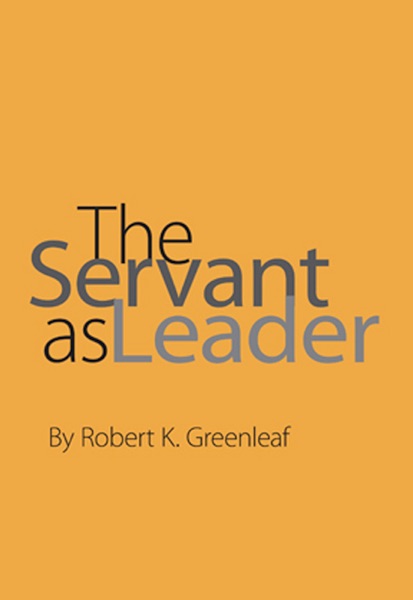
The Servant as Leader
📖 About the book
The Servant as Leader by Robert Greenleaf, originally published as an essay in 1970, is the foundational work that birthed the Servant Leadership movement. Greenleaf, a former AT&T executive, argues that the best leaders are those who are servants first. He challenges the traditional 'Top-Down' authority model, proposing instead that a leader’s primary responsibility is to ensure that other people's highest priority needs are being served, fundamentally redefining the ethical and social purpose of management.
The book details the concept of Foresight as the 'central ethic' of leadership—the ability to understand the lessons of the past, the realities of the present, and the likely consequence of a decision for the future. Greenleaf emphasizes Persuasion over coercion and the role of the leader as a 'healer' who builds community. He introduces the Best Test of servant leadership: Do those served grow as persons? Do they, while being served, become healthier, wiser, freer, and more likely themselves to become servants? The focus is on Institutional Integrity and the creation of high-trust organizations.
This is mandatory reading for non-profit directors, corporate executives, and educators. Readers gain value by learning how to lead with Humility and Empathy to build intense organizational loyalty. Practical applications include redesigning Governance Structures to be more inclusive and utilizing 'Listening Groups' to inform strategic direction. By internalizing Greenleaf’s philosophy, leaders can build organizations that are not only more sustainable but also more human, attracting individuals who are motivated by a deep sense of service and strategic contribution.
💡 Key takeaways
Adopt the Servant-First Mindset, recognizing that your primary strategic duty is to empower and develop your team members rather than exercising personal power.
Develop your Strategic Foresight by systematically analyzing historical patterns and current market data to anticipate the long-term consequences of your organizational choices.
Utilize Persuasion-Based Leadership to build consensus and alignment, ensuring that your team follows your vision through voluntary commitment rather than mandated compliance.
❓ FAQ
Is "The Servant as Leader" by Robert Greenleaf free to download?
Yes. BookHubs provides a free preview for "The Servant as Leader". For the full legal text we link to OpenLibrary (Internet Archive), which is also free to read.
What is "The Servant as Leader" about?
Free download of the foundational text on Servant Leadership. Learn how to lead by putting the growth and well-being of your people first.
How long does it take to read "The Servant as Leader"?
At an average reading pace of ~250 words per minute, "The Servant as Leader" (336 pages) takes roughly 504 minutes — about 8.4 hours. The 3 key takeaways on this page cover the core ideas in under 5 minutes.
What is the ISBN of "The Servant as Leader"?
The ISBN of "The Servant as Leader" by Robert Greenleaf is 978-0809105540, published by Paulist Press.
📚 Related books
All books →
The 21 Irrefutable Laws of Leadership
John Maxwell

Dare to Lead
Brené Brown

How to Win Friends and Influence People
Dale Carnegie

Shoe Dog
Phil Knight

The Laws of Human Nature
Robert Greene

Think Again
Adam Grant