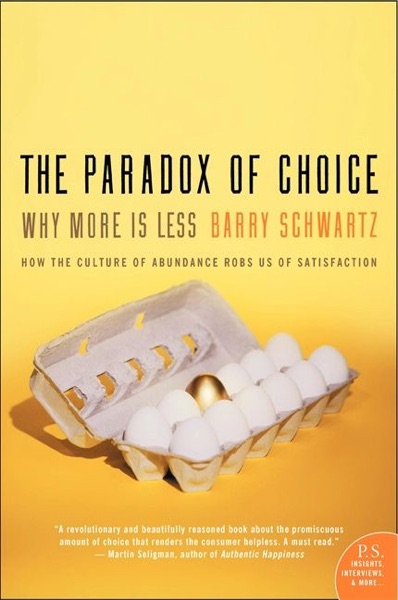
The Paradox of Choice
📖 About the book
The Paradox of Choice: Why More Is Less by Barry Schwartz, published in 2004, is a seminal work on Decision-Making Psychology. Schwartz argues that while Western culture values freedom of choice, an overabundance of options leads to 'Choice Paralysis' and increased anxiety. This book provides a rigorous framework for understanding how to manage the cognitive load of modern markets, offering leaders the tools to design better product portfolios and employee experiences by simplifying the decision architecture.
The core methodology identifies two types of decision-makers: Maximizers (who seek the absolute best) and Satisficers (who seek 'good enough'). Schwartz explains the concepts of Opportunity Cost and 'Regret,' showing how constant comparison diminishes our satisfaction with even the best choices. He introduces techniques for Voluntary Constraints and provide frameworks for reducing consumer friction. The focus is on moving from 'Excessive Variety' toward Curated Excellence, where strategic impact is maximized through clarity and focus.
This is mandatory reading for product managers, marketing directors, and experience designers. Readers gain concrete value by learning how to reduce Decision Fatigue in their customers and workforce. Practical applications include utilizing the 'Satisficing Strategy' for routine business choices and redesigning product lines to eliminate Choice Overload. By mastering Schwartz’s insights, leaders can ensure their organizational offerings are more user-friendly and persuasive, driving higher conversion and customer loyalty through the power of less.
💡 Key takeaways
Adopt a Satisficing Mindset for non-critical strategic decisions, setting clear 'good enough' criteria to avoid the waste of time and mental energy caused by over-analysis.
Reduce Choice Overload for your customers by curating your product offerings, recognizing that simplifying the decision process significantly increases conversion rates.
Manage Opportunity Cost by focusing on the benefits of your chosen strategic path rather than constantly ruminating on the 'missed' potential of the alternatives you rejected.
❓ FAQ
Is "The Paradox of Choice" by Barry Schwartz free to download?
Yes. BookHubs provides a free preview for "The Paradox of Choice". For the full legal text we link to OpenLibrary (Internet Archive), which is also free to read.
What is "The Paradox of Choice" about?
Free download of the classic on decision-making. Learn how to manage 'Choice Overload' to increase satisfaction and improve organizational performance.
How long does it take to read "The Paradox of Choice"?
At an average reading pace of ~250 words per minute, "The Paradox of Choice" (265 pages) takes roughly 398 minutes — about 6.6 hours. The 3 key takeaways on this page cover the core ideas in under 5 minutes.
What is the ISBN of "The Paradox of Choice"?
The ISBN of "The Paradox of Choice" by Barry Schwartz is 978-0060005689, published by Ecco.
📚 Related books
All books →
Atomic Habits
James Clear

Can't Hurt Me
David Goggins

Ego Is the Enemy
Ryan Holiday

Influence
Robert Cialdini

Man's Search for Meaning
Viktor Frankl

Never Split the Difference
Chris Voss