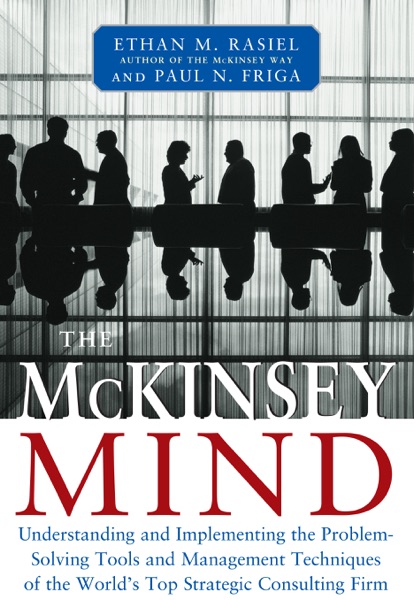
The McKinsey Mind
by Paul Friga
📖 About the book
The McKinsey Mind by Paul Friga and Ethan Rasiel, published in 2001, is the advanced follow-up to The McKinsey Way. While the first book focused on the firm's general principles, this volume dives deeper into the specific Analytical Tools and frameworks used to execute large-scale strategic engagements. It provides a more technical and procedural guide for managing teams, analyzing data, and synthesizing results into actionable recommendations, making it an indispensable resource for anyone in a high-stakes analytical role.
The authors provide a step-by-step framework for Data-Driven Problem Solving, covering everything from framing the problem to data collection and interpretation. They introduce concepts like Logic Trees and the use of "Ghost Decks" to plan research projects. A significant portion is dedicated to Team Management, highlighting McKinsey's collaborative culture and the use of structured brainstorming. They emphasize the importance of "Synthesizing" rather than just summarizing, ensuring that every piece of data is turned into a "So What?" insight that directly impacts the strategic direction of the firm.
This is critical reading for senior analysts, project leads, and strategy consultants. Readers gain concrete value by learning how to manage large, complex research projects without getting lost in the details. Practical applications include utilizing Issue Trees to identify root causes and implementing the "Daily Stand-up" for better team coordination. By mastering the McKinsey mind, leaders can ensure that their organization's decisions are grounded in rigorous evidence and logical consistency, leading to more predictable and impactful strategic growth.
💡 Key takeaways
Utilize Logic Trees and Issue Trees to visually break down complex strategic questions into discrete, testable components that guide your data collection efforts.
Apply the 'So What?' Test to every piece of information you gather, ensuring that your analysis moves beyond simple facts toward actionable strategic insights.
Implement Ghost Decks and Storyboards early in your project to plan your research and ensure your team is aligned on the final structure of your recommendations.
❓ FAQ
Is "The McKinsey Mind" by Paul Friga free to download?
Yes. BookHubs provides a free preview for "The McKinsey Mind". For the full legal text we link to OpenLibrary (Internet Archive), which is also free to read.
What is "The McKinsey Mind" about?
Download the follow-up to 'The McKinsey Way' for free. Learn the advanced tools and techniques for data-driven strategic problem solving.
How long does it take to read "The McKinsey Mind"?
At an average reading pace of ~250 words per minute, "The McKinsey Mind" (256 pages) takes roughly 384 minutes — about 6.4 hours. The 3 key takeaways on this page cover the core ideas in under 5 minutes.
What is the ISBN of "The McKinsey Mind"?
The ISBN of "The McKinsey Mind" by Paul Friga is 978-0071374293, published by McGraw-Hill.
📚 Related books
All books →
7 Habits of Highly Effective People
Stephen Covey

High Output Management
Andrew Grove

The Righteous Mind
Jonathan Haidt

Antifragile
Nassim Taleb

Business Model Generation
Osterwalder, Pigneur

Management
Peter Drucker