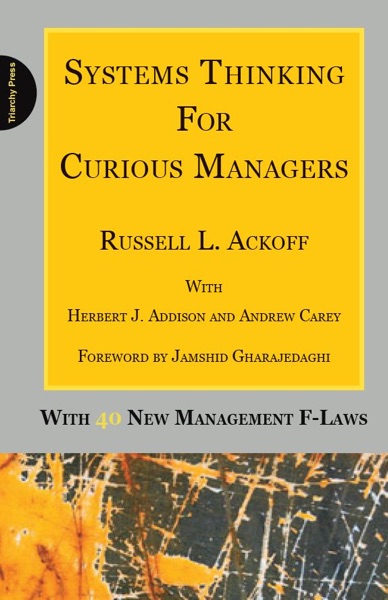
Systems Thinking in Management
📖 About the book
Systems Thinking in Management by Russell Ackoff is a foundational work that challenged the traditional 'reductionist' approach to business. Ackoff, a pioneer in the field of operations research and systems theory, argues that management is not about fixing parts in isolation, but about managing the Interactions of Parts. He contends that an organization is a system, and its performance depends more on how its components work together than on how they work separately, fundamentally changing how leaders approach problem-solving.
The book introduces the concept of Synthetic Thinking, which focuses on the whole and the function of the system within its larger environment. Ackoff details the difference between doing things right (efficiency) and doing the right things (effectiveness), emphasizing that solving the wrong problem perfectly is the greatest danger in management. He explores Organizational Messes—complex systems of interacting problems—and provides a framework for 'designing the future' through idealized planning and a focus on purposeful, human-centric systems.
Essential for strategic planners, engineers, and executives dealing with complex global operations. Readers gain value by learning how to identify the root causes of systemic failure that traditional analysis misses. Practical applications include utilizing Idealized Design to reinvent business processes and restructuring departments to optimize flow rather than local output. By adopting Ackoff’s systems perspective, leaders can create more resilient, integrated organizations that are capable of navigating the interconnected challenges of the modern economy.
💡 Key takeaways
Apply Synthetic Thinking to your organization, focusing on how the interactions between departments create value rather than optimizing individual units in isolation.
Distinguish between Efficiency and Effectiveness to ensure your team is not perfectly solving the wrong problems or improving processes that should be eliminated entirely.
Utilize Idealized Design to envision your organization’s optimal future state and work backward to identify the systemic changes required to achieve that vision.