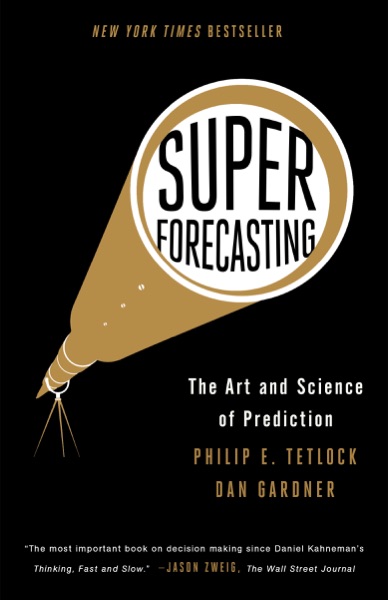
Superforecasting
by Philip Tetlock, Dan Gardner
📖 About the book
Superforecasting: The Art and Science of Prediction by Philip Tetlock and Dan Gardner, published in 2015, is based on a massive study of forecasting accuracy sponsored by the US intelligence community. Tetlock argues that prediction is not a gift of genius but a Trainable Skill. This book provides a rigorous framework for Probabilistic Thinking, identifying the habits of 'Superforecasters'—individuals who consistently out-perform intelligence analysts and sophisticated software in predicting global events.
The methodology identifies traits such as Active Open-Mindedness, intellectual humility, and the use of 'Fermi Estimations.' Tetlock explains how to break big questions into 'Sub-problems' and details the importance of Bayesian Updating—adjusting forecasts incrementally as new data arrives. He introduces the Outside View vs. Inside View distinction and provides strategies for avoiding 'The Hedgehog's Trap' (oversimplification). The focus is on moving from 'Confident Guesses' toward Statistical Precision and rigorous record-keeping.
Essential reading for risk managers, strategic analysts, and C-suite leaders who make multi-year plans. Readers gain concrete value by learning how to build Forecasting Teams within their firms. Practical applications include utilizing 'Brier Scores' to track prediction accuracy and implementing Post-Event De-biasing. By mastering the art of superforecasting, leaders can significantly increase their organization's foresight and ensure that their strategic investments are grounded in the highest-quality probability analysis.
💡 Key takeaways
Adopt Bayesian Updating in your strategic planning, ensuring that your organization's forecasts are consistently refined in response to every new piece of market data.
Utilize the Outside View first, using base-rate data from similar historical situations to anchor your expectations before analyzing the specifics of your current strategic project.
Foster Intellectual Humility within your team, rewarding those who treat their beliefs as 'hypotheses to be tested' rather than absolute truths that must be defended.
❓ FAQ
Is "Superforecasting" by Philip Tetlock, Dan Gardner free to download?
Yes. BookHubs provides a free preview for "Superforecasting". For the full legal text we link to OpenLibrary (Internet Archive), which is also free to read.
What is "Superforecasting" about?
Free download of the guide to the art of prediction. Master the habits of Superforecasters to improve your organization's strategic foresight and accuracy.
How long does it take to read "Superforecasting"?
At an average reading pace of ~250 words per minute, "Superforecasting" (352 pages) takes roughly 528 minutes — about 8.8 hours. The 3 key takeaways on this page cover the core ideas in under 5 minutes.
What is the ISBN of "Superforecasting"?
The ISBN of "Superforecasting" by Philip Tetlock, Dan Gardner is 978-0804136716, published by Crown.


