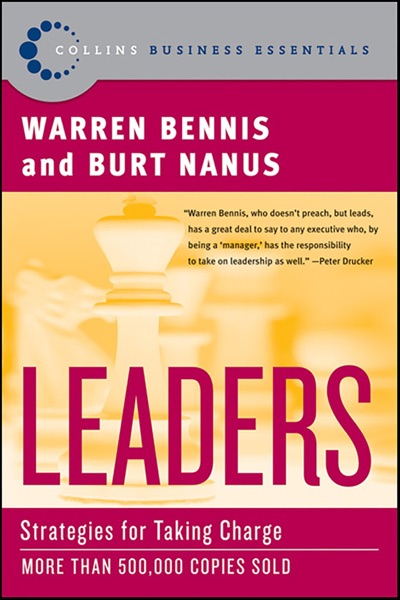
Leaders
📖 About the book
Leaders: Strategies for Taking Charge by Warren Bennis and Burt Nanus, published in 1985, is based on an extensive study of 90 top leaders, from corporate CEOs to orchestra conductors. The authors argue that while management is about 'doing things right,' leadership is about 'doing the right things.' This work provides a rigorous, data-backed framework for Transformational Leadership, identifying the specific behaviors that allow individuals to translate a compelling vision into organizational reality and sustained market success.
The framework identifies Four Key Competencies: Attention through Vision, Meaning through Communication, Trust through Positioning, and the Deployment of Self. Bennis and Nanus explain the concept of the Wallenda Factor—the ability to focus on success rather than the fear of failure. They emphasize the role of the leader as a 'social architect' who designs the organizational culture and information systems needed to support a shared mission. The focus is on moving beyond incremental management to create 'momentum' and 'empowerment' across the entire workforce.
This is essential reading for mid-to-senior executives and organizational designers. Readers gain concrete value by learning how to build Institutional Trust through consistent behavior and clear positioning. Practical applications include utilizing 'Vision-Mapping' to align the board and redesigning internal communication to favor Narrative Leadership. By mastering these four strategies, leaders can move from being passive administrators to becoming active catalysts for organizational growth, ensuring that their firms remain relevant and competitive in a changing global landscape.
💡 Key takeaways
Achieve Attention through Vision by providing your team with a clear, compelling picture of the future that simplifies complex strategic choices and coordinates effort.
Master the Deployment of Self by recognizing your own strengths and weaknesses, ensuring that your leadership style is focused on results rather than personal ego.
Cultivate the Wallenda Factor within your organization, fostering a high-performance culture that focuses on successful execution rather than the avoidance of strategic failure.
❓ FAQ
Is "Leaders" by Warren Bennis, Burt Nanus free to download?
Yes. BookHubs provides a free preview for "Leaders". For the full legal text we link to OpenLibrary (Internet Archive), which is also free to read.
What is "Leaders" about?
Free download of the definitive study on leadership strategies for free. Master the four competencies that drive organizational transformation and excellence.
How long does it take to read "Leaders"?
At an average reading pace of ~250 words per minute, "Leaders" (272 pages) takes roughly 408 minutes — about 6.8 hours. The 3 key takeaways on this page cover the core ideas in under 5 minutes.
What is the ISBN of "Leaders"?
The ISBN of "Leaders" by Warren Bennis, Burt Nanus is 978-0060559670, published by Harper & Row.
📚 Related books
All books →
The 21 Irrefutable Laws of Leadership
John Maxwell

Dare to Lead
Brené Brown

How to Win Friends and Influence People
Dale Carnegie

Shoe Dog
Phil Knight

The Laws of Human Nature
Robert Greene

Think Again
Adam Grant